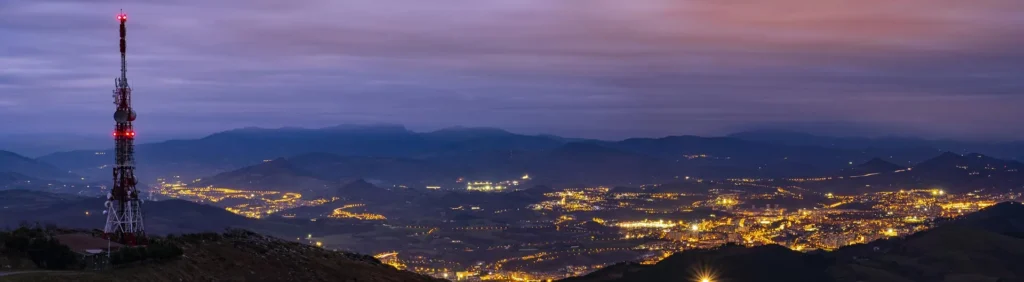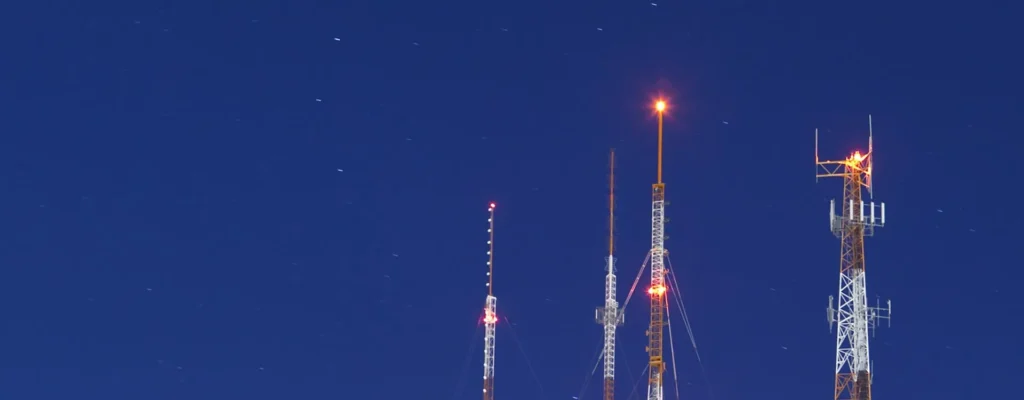
Every FAA-lit tower uses one of a handful of standard obstruction lighting system types, and which one your structure needs depends on its height, location, and daytime visibility. In this guide we explain the FAA tower lighting system types: the red, white, and dual configurations, the L-810, L-864, and L-865 equipment behind them, and the standard system layouts labeled A to G.
Obstruction lighting systems protect aircraft operating in the national airspace. When a tower’s lighting system fails, it can create a hazard to aviation and trigger regulatory obligations for the tower owner.
Managing tower lighting compliance is more complex than most operators expect. It typically involves:
- Understanding FAA obstruction marking and lighting standards
- Monitoring obstruction lights continuously
- Detecting and reporting outages within required timeframes
- Maintaining daily observation logs and inspection records
- Coordinating repairs and maintenance
- Maintaining documentation for regulatory compliance
This guide focuses on the lighting systems themselves. For the owner compliance obligations that come with any lit tower, including monitoring, outage reporting, inspections, and recordkeeping, see our complete guide to FAA tower lighting requirements.
Why Tower Lighting Compliance Exists
Tall structures can present a hazard to aircraft operating at low altitude. To mitigate this risk, the Federal Aviation Administration establishes standards for marking and lighting structures that may affect navigable airspace.
These standards are published in FAA Advisory Circular 70/7460-1N, Obstruction Marking and Lighting, which provides guidance for the marking and lighting of structures that may pose hazards to aviation.
The goal is simple:
Ensure tall structures are visible to pilots both day and night.
Obstruction lighting systems allow pilots to identify towers and avoid collisions during:
- Night operations
- Low visibility conditions
- Agricultural aviation
- Helicopter operations
- Low-altitude flight corridors
Many modern lighting systems now also include infrared (IR) capability to ensure visibility for aircraft using night-vision equipment.
Which Towers Require Obstruction Lighting?
Not every tower requires aviation lighting. Under 14 CFR Part 77, Safe, Efficient Use, and Preservation of the Navigable Airspace, certain structures must be reported to the FAA for evaluation. Specifically, structures exceeding 200 feet above ground level (AGL) must be reported to the FAA using FAA Form 7460-1.
After reviewing the structure’s height, location, and potential impact on aviation operations, the FAA issues a determination specifying whether the structure must be:
- Marked
- Lighted
- Both marked and lighted
Even structures below 200 ft AGL may require lighting if they penetrate protected airspace surfaces near airports.
Types of FAA Obstruction Lighting Systems
The FAA recognizes several obstruction lighting configurations depending on tower height, location, and aviation visibility requirements.
Lighting standards and configurations are described in FAA Advisory Circular 70/7460-1N, Obstruction Marking and Lighting.
Red Obstruction Lighting Systems
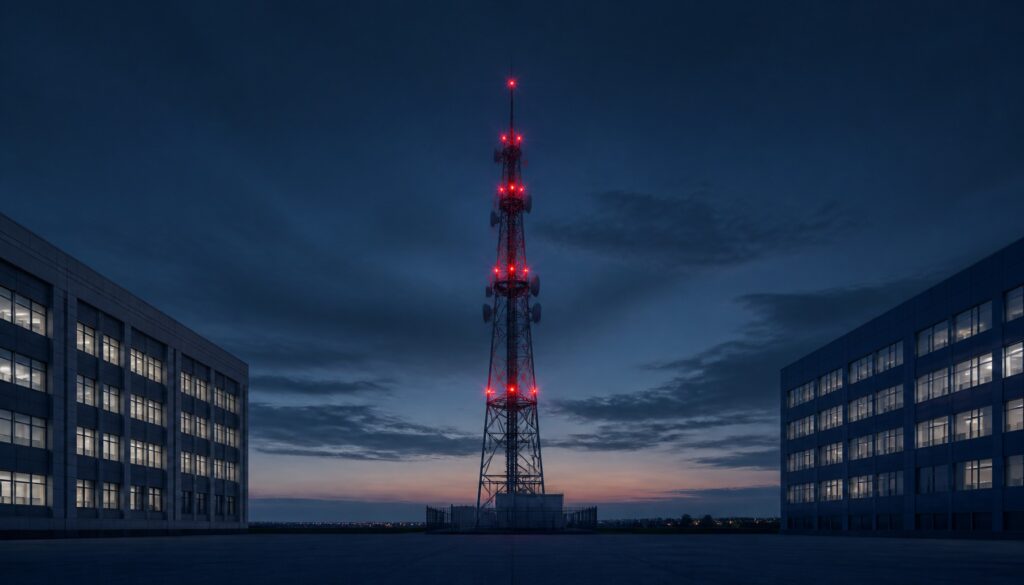
Red lighting systems are one of the most common tower lighting configurations. These are typically found on Type A towers.
Characteristics include:
- Flashing or steady-burning red lights
- Used primarily during nighttime operations
- Installed at multiple elevations on the structure
Common equipment types include:
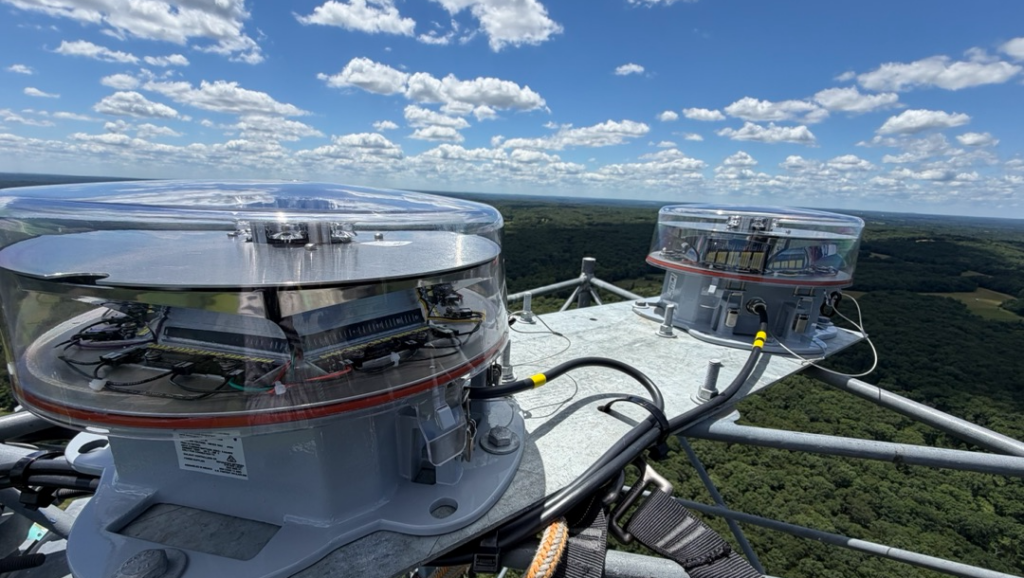
- L-810 low-intensity red lights
- L-864 medium-intensity flashing red beacons
These systems provide nighttime visibility without bright daytime flashes.
High-Intensity White Lighting
High-intensity white systems use flashing white strobes during daytime hours. These are typically found on Type B, C, and D towers.
Characteristics include:
- High-visibility daytime strobes
- Reduced need for tower paint markings
- Lighting installed at multiple tower elevations
Typical equipment classification:
- L-865 flashing white obstruction lights
Dual Mode Lighting Systems
Dual mode lighting systems combine two lighting modes:
- White strobes during daytime
- Red obstruction lights during nighttime
This configuration provides strong daytime visibility while minimizing nighttime glare. These are typically found on Type E, F, and G towers.
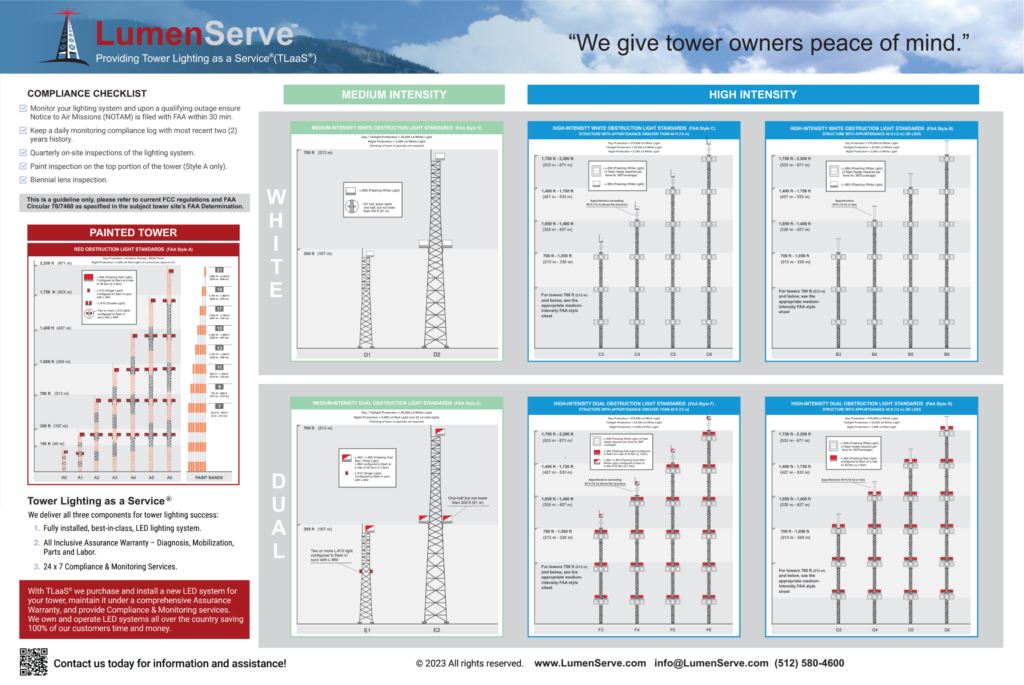
FAA Lighting System Types (A to G)
The FAA defines several standard lighting configurations commonly used on communications towers. These are described in FAA Advisory Circular 70/7460-1N, Obstruction Marking and Lighting. While tower lighting configurations vary depending on structure height and location, the following system types are commonly referenced in engineering and tower lighting specifications.
Type A
- Red obstruction lighting system
- Used primarily on shorter towers
- Typically includes L-810 steady-burning red lights
Type B
- High-intensity white lighting system
- Uses L-865 flashing white lights
- Designed for daytime visibility
Type C
- High-intensity white lighting with additional lighting levels
- Often used on taller towers requiring multiple lighting tiers
Type D
- Medium-intensity white lighting configuration with additional lighting coverage
- Designed for structures requiring enhanced daytime conspicuity
Type E
- Dual lighting system
- White strobes during daytime
- Red obstruction lighting during nighttime
Type F
- Dual system with additional red lighting tiers
- Often used on taller communications towers
Type G
- Dual lighting system with enhanced redundancy and additional lighting levels
- Typically used on very tall broadcast structures
The FAA determines the appropriate lighting system based on the results of the aeronautical study conducted during the FAA Form 7460-1 review process.
Who Is Responsible for Tower Lighting Compliance?
For most communications towers, the antenna structure owner listed in the FCC Antenna Structure Registration (ASR) is responsible for maintaining compliant obstruction lighting. These requirements are established in 47 CFR Part 17, Construction, Marking, and Lighting of Antenna Structures. Even when towers are leased to tenants, the ASR registrant remains responsible for ensuring the required lighting system remains operational.
Tower owner responsibilities typically include:
- Ensuring required obstruction lights operate properly
- Monitoring lighting systems continuously
- Reporting qualifying outages
- Maintaining daily observation logs
- Performing scheduled inspections
- Maintaining compliance records
- Coordinating repairs when failures occur
Monitoring Tower Lighting Systems
Under 47 CFR §17.47, tower lighting systems must be monitored to ensure lighting failures are detected quickly.
Monitoring may be performed through:
- Daily visual observation, or
- Automatic monitoring systems capable of detecting lighting failures
Most modern towers use automated monitoring systems connected to the lighting controller.
These systems typically detect:
- Individual beacon failures
- Top beacon outages
- Power interruptions
- Controller malfunctions
- Photocell failures
- Communication loss with the lighting controller
When a failure occurs, the system generates an alarm so operators can respond immediately.
Daily Observation and Logging
If automated monitoring is not used, 47 CFR §17.47(a) requires tower owners to visually observe the lighting system at least once every 24 hours.
This typically requires:
- Observing the lighting system daily
- Verifying required lights are operating
- Recording the observation in a daily log
Typical daily log entries include:
- Date and time of observation
- Observer name
- Lighting status confirmation
- Notes regarding irregularities
Tower Light Outages and NOTAM Reporting
When required obstruction lights fail, tower owners must take immediate action. Under 47 CFR §17.48, lighting outages that cannot be corrected within 30 minutes must be reported so a NOTAM can be issued warning pilots of the outage.
Typical outage response process:
- Detect the lighting failure
- Confirm the outage condition
- Notify the FAA Flight Service Station
- Request issuance of a NOTAM
- Coordinate repair of the lighting system
- Notify the FAA when the lighting system is restored so the NOTAM can be cancelled
Inspection and Maintenance Requirements
Obstruction lighting systems require regular inspection and maintenance to remain compliant.
Inspection responsibilities are described in 47 CFR Part 17, Construction, Marking, and Lighting of Antenna Structures and in FAA obstruction lighting guidance.
Quarterly Control Device Inspections
Under 47 CFR §17.47(b), lighting control equipment and alarm systems must be inspected at least every three months.
These inspections verify:
- Controller functionality
- Alarm system operation
- Monitoring system performance
- Photocell switching behavior
Biennial Lens and Lighting Inspections
Lighting lenses must be inspected and cleaned periodically to ensure they remain visible to pilots.
Over time lenses can accumulate:
- Dust
- Environmental debris
- Insect buildup
- UV damage
Dirty lenses can significantly reduce visibility and should be cleaned or replaced when necessary.
Routine System Inspections
Routine inspections verify:
- Lighting levels remain operational
- Flash patterns match FAA specifications
- Lighting systems remain synchronized
- Electrical components remain functional
Documentation and Compliance Records
Tower owners must maintain documentation demonstrating that lighting systems are properly monitored and maintained.
Typical records include:
- Daily observation logs
- Monitoring system alarms
- Quarterly inspection reports
- Maintenance records
- Outage reports
- Restoration confirmations
Maintaining accurate records helps demonstrate compliance with FCC antenna structure rules.
Common Tower Lighting Violations That Trigger FCC Enforcement
Most enforcement actions occur because basic operational requirements were not followed.
Common violations include:
Failure to Monitor Lighting Systems
- Lighting must be monitored either through daily observation or automated monitoring
Failure to Report Lighting Outages
- Delayed NOTAM reporting is one of the most common violations under 47 CFR §17.48
Failure to Maintain Lighting Equipment
Common issues include:
- Dirty lenses
- Failed beacons
- Non-functioning lighting levels
Failure to Maintain Records
- Missing inspection logs can create compliance risk
Failure to Repair Lighting Systems Promptly
- Extended outages increase aviation safety risk and regulatory exposure
A Simpler Way to Manage Tower Lighting
Because tower lighting compliance requires monitoring, inspections, reporting, and documentation, many operators choose to outsource these responsibilities.
With Tower Lighting as a Service (TLaaS®), LumenServe manages:
- Purchase of lighting system
- Full lighting system installation
- Continuous monitoring
- Outage detection and reporting
- Inspection scheduling
- Maintenance and repairs
- Compliance documentation
How LumenServe Helps Tower Owners Stay Compliant
LumenServe provides Tower Lighting as a Service (TLaaS®) designed specifically for tower operators.
LumenServe manages:
- 24/7 tower monitoring
- NOTAM outage reporting
- Inspection scheduling
- Lighting maintenance and repairs
- Compliance documentation
The result:
- Increased uptime
- Reduced operational complexity
- Predictable costs
- Confidence that towers remain compliant
When a light fails, see how to file and clear a NOTAM, and what non-compliance can cost in FCC tower lighting fines. Changing your tower marking approach? See how to convert a Style A tower to Style E.
Frequently Asked Questions About FAA Tower Lighting System Types
What is the difference between Type A and Type E tower lighting?
Type A is a red obstruction lighting system using L-810 steady-burning red lights, most common on shorter towers. Type E is a dual system, white strobes during the day and red lights at night, typically used on taller structures that need stronger daytime visibility.
What do L-810, L-864, and L-865 mean?
These are FAA fixture classifications named in Advisory Circular 70/7460-1N. L-810 is a low-intensity steady-burning red light. L-864 is a medium-intensity flashing red beacon. L-865 is a medium-intensity flashing white light used in high-intensity and dual systems.
Who decides which lighting system type a tower needs?
The FAA does, during the aeronautical study triggered by FAA Form 7460-1. The determination is based on the structure’s height, location, and potential effect on navigable airspace, not the tower owner’s preference.
Can a tower owner switch from red to a dual white and red lighting system?
Yes, this is a common upgrade, most often to reduce visual impact for nearby residents or to modernize aging equipment. Any change still needs to match an FAA-approved configuration, most commonly a Style A to Style E conversion.
Does every FAA-lit tower need red obstruction lights?
No. Some structures use high-intensity white strobes alone, Types B, C, and D, or a dual configuration, Types E, F, and G, instead of red lighting, depending on height, daytime visibility needs, and community or environmental considerations.
Does the lighting system type change the monitoring requirements?
No. Regardless of system type, 47 CFR §17.47 requires the lighting to be monitored continuously or observed daily, and any outage that cannot be fixed within 30 minutes must be reported so a NOTAM can be issued.
Book a Call
Managing tower lighting compliance shouldn’t consume your operational resources.
Book a Call to learn how LumenServe can simplify tower lighting compliance across your portfolio.