Key Takeaways
- Antenna Structure Registration (ASR) is not a one-time filing; it is the start of a lifelong compliance obligation for your tower’s marking and lighting.
- You cannot register a structure with the FCC until you complete the FAA aeronautical study (Form 7460-1) and receive a determination letter that specifies your exact lighting configuration.
- The registered structure owner is primarily accountable to the FCC and FAA for lighting compliance, monitoring, and NOTAM filing obligations, although tenant licensees can also be held responsible if the owner fails to comply.
- Environmental and historic preservation reviews (NEPA/NHPA) are a mandatory part of the ASR process and a frequent source of significant project delays.
- Existing structures are typically grandfathered under the advisory circular in effect when they were built, but certain changes can alter the specific advisory circular a tower falls under for compliance. Always check with the appropriate governing bodies to confirm.
For most tower owners, Antenna Structure Registration feels like a procedural checkbox. During a new build or an acquisition, you encounter the need to file paperwork with the FCC, get a number, and move on. This view is incomplete.
The ASR filing is not the end of a process. It is the beginning of a binding compliance obligation that dictates your obstruction lighting configuration, your marking requirements, and your ongoing accountability to both the FCC and FAA for the life of the structure. A single unresolved discrepancy between an FAA determination letter and the lighting actually installed on a tower can expose the owner to FCC enforcement, including Notices of Violation and fines, along with disputes with tenants.
Most guides on this topic stop at the filing step. As an operator, you need to understand the full pipeline: from the initial FAA aeronautical study, through the FCC registration, and into the operational duties that follow. This guide explains what triggers registration, how the FAA and FCC processes connect, what environmental reviews are required, which lighting and marking specifications your determination letter locks in, and who holds the liability after the filing is complete.
What Antenna Structure Registration Is and When It Is Required
First, let’s be precise about what we’re discussing. An antenna structure registration is the process of logging a specific type of structure in the FCC’s database to ensure it does not pose a hazard to air navigation. According to the governing regulation, 47 CFR Part 17 , an “antenna structure” includes the radiating system, its supporting structures, and any appurtenances mounted on them.
This definition is specific. It does not include buildings, bridges, water towers, or other tall structures unless they are intended to support antennas. For example, if a telecom operator mounts a new antenna array and mast on an existing building rooftop, it is the antenna structure (the mast and its equipment) that requires registration, not the building itself. This is a common point of confusion that can lead to incorrect filings. The registration creates a public record of the structure’s location, height, ownership, and its required obstruction marking and lighting.
Mandatory Registration Thresholds Under Part 17
Registration is not optional if your structure meets certain criteria. The FCC mandates registration for any proposed or existing antenna structure that requires notification to the Federal Aviation Administration (FAA). This FAA notification requirement is the gateway.
Generally, you must notify the FAA if your structure:
- Exceeds 200 feet in height above ground level (AGL).
- Is located near a public-use or military airport, heliport, or seaplane base, within specified distances and glide slopes, regardless of its height.
The Notice Criteria Tool can be found on the FAA OE/AAA page , and the FCC offers a comparable screening tool, TOWAIR. A structure under 200 feet AGL can still require FAA notification if it is located near an airport runway, and that notification requirement in turn triggers the FCC registration requirement.
Voluntary Registration and Co-Location Exemptions
Structure owners can also voluntarily register structures that do not meet the mandatory thresholds. This is sometimes done to formally document a structure’s existence and lighting configuration in the federal database, which can simplify future modifications or tenant negotiations.
A frequent question arises with co-locations: does a tenant mounting new antennas on an existing, registered tower need their own ASR? The answer is no. The registration applies to the structure itself, and that obligation sits with the structure owner. However, this doesn’t mean co-locations are free of regulatory triggers. If a tenant’s installation changes the overall height or profile of the structure, the owner must file a modification to the existing ASR, which may require a new FAA study.
How the FAA Aeronautical Study Connects to FCC Registration
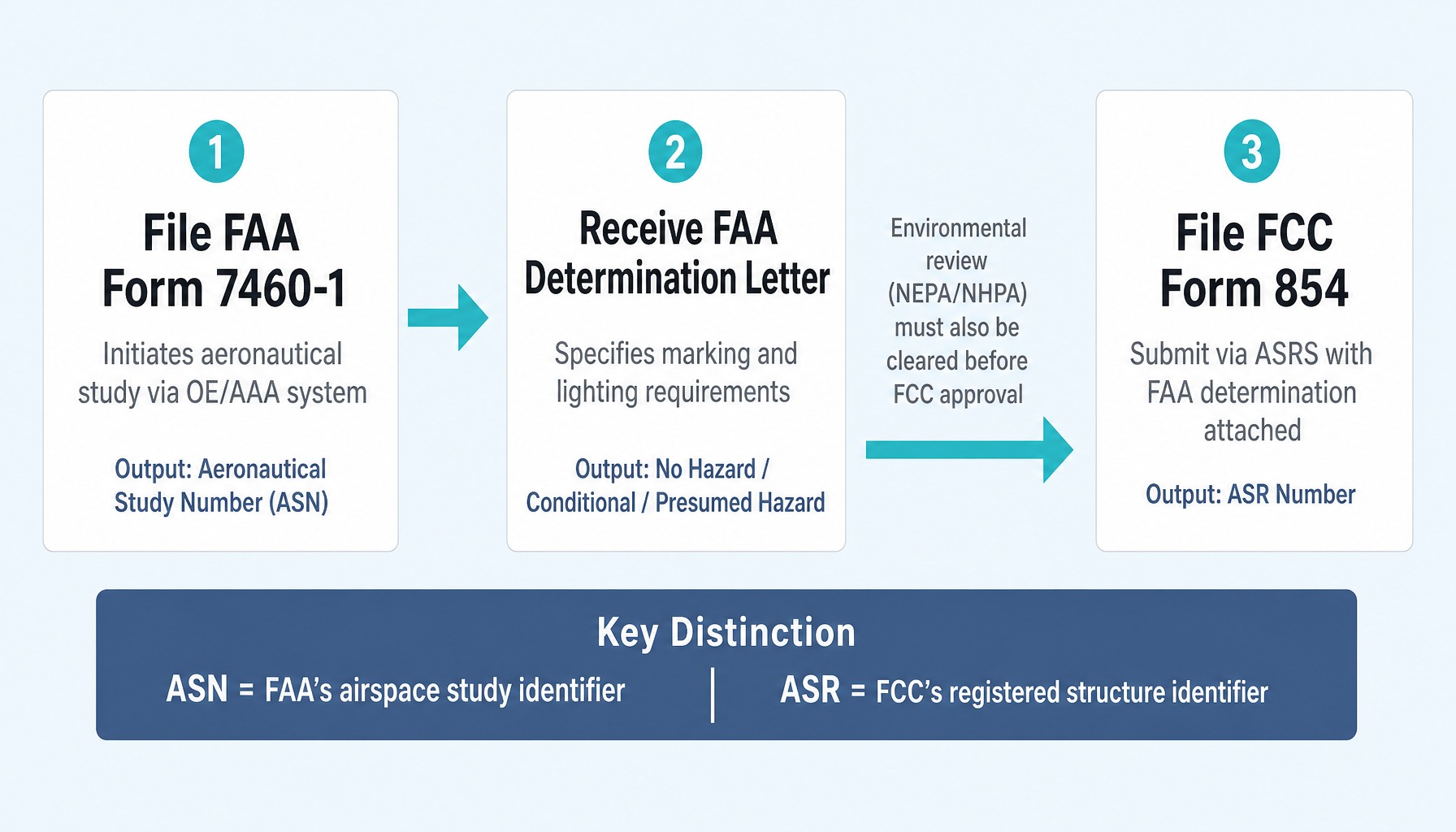
Here is the most critical procedural point that operators often misunderstand: you cannot complete an FCC antenna structure registration until you have first gone through the FAA’s aeronautical study process. The FAA study dictates the terms of your registration. The sequence is non-negotiable.
-
File FAA Form 7460-1: The process begins when the structure owner files a “Notice of Proposed Construction or Alteration” (FAA Form 7460-1) with the FAA. This is typically done online through the Obstruction Evaluation / Airport Airspace Analysis (OE/AAA) system. This filing officially notifies the FAA of your intent to build or modify a structure and initiates the aeronautical study.
-
Receive the FAA Determination Letter: After its review, the FAA issues a formal determination. This document, often called the “det letter,” will typically be a Determination of No Hazard to Air Navigation or, less commonly, a Determination of Hazard. If the FAA’s initial review finds a potential problem, it may first issue a Notice of Presumed Hazard, giving the sponsor a chance to lower or relocate the structure before a final determination. A no-hazard finding does not mean no lighting is required; it means the structure is approved on the condition that you follow the specific marking and lighting requirements detailed in the letter. This det letter is the single most important document defining your long-term compliance duties.
-
File FCC Form 854: With the FAA determination in hand and its associated Aeronautical Study Number (ASN) you can now file FCC Form 854 via the online Antenna Structure Registration System (ASRS) . You will provide the structure details and upload the FAA determination. Once the FCC approves the filing, it assigns an official ASR number, which must be posted at the site.
It’s essential to understand that the FAA’s Aeronautical Study Number (ASN) and the FCC’s Antenna Structure Registration (ASR) number are not the same. The ASN is the FAA’s identifier for the airspace study; the ASR number is the FCC’s identifier for the registered asset. Confusing the two is a common administrative error.
Environmental and Historic Preservation Reviews That Delay Registration
The procedural steps with the FAA and FCC are straightforward. The most common source of unexpected and lengthy delays in the antenna structure registration process comes from a different corner: environmental and historic preservation reviews.
Before the FCC will grant an ASR, the applicant must certify compliance with the National Environmental Policy Act (NEPA) and Section 106 of the National Historic Preservation Act (NHPA) . In practice, this means initiating a review through the FCC’s Tower Construction Notification System (TCNS) . This system notifies Tribal Historic Preservation Officers (THPOs), State Historic Preservation Officers (SHPOs), and other interested parties.
An FCC Form 854 filing for a new registration can stall for months if the environmental review triggers a historic preservation consultation that was not anticipated. A structure planned for a rural area with no obvious historic sites can be flagged by a THPO due to its proximity to a culturally significant landscape. If a party raises a concern, the applicant must engage in consultation, which can involve site assessments and documentation, holding the ASR filing in limbo until the issue is resolved.
Because of this, one optional best practice is to initiate the TCNS notification process as early as possible ideally at the same time you file the FAA Form 7460-1, not after you receive the determination.
Marking and Lighting Requirements Your ASR Determination Letter Locks In
The FAA determination letter does not just approve your structure; it specifies the exact obstruction marking and lighting configuration you must install and maintain. This is the moment your ASR transitions from a paperwork exercise into a tangible, long-term operational and financial obligation. The det letter will reference the edition of FAA Advisory Circular 70/7460-1, Obstruction Marking and Lighting, in effect at the time of the determination, and prescribe the lighting system your structure requires. These are not suggestions; they are federal requirements tied directly to your ASR number.
How Your Determination Letter Dictates Lighting Configuration
The FAA determines the required lighting based on the structure’s height, type, and location relative to VFR flight routes, IFR procedures, and nearby airfields. The det letter will specify whether the system must be red (L-864), white (L-865), or dual-mode (L-864/L-865), and what intensity is required (low, medium, or high). The lighting system installed on the tower must match the det letter’s specifications exactly. The configuration is prescribed by the FAA, not by the lighting provider. LumenServe installs and maintains systems to the specifications in each structure’s determination letter and the applicable advisory circular.
Read more: FAA Tower Lighting Compliance: The Complete Guide
Where a det letter requires obstruction marking, the paint obligation is ongoing. Paint degrades at different rates depending on regional weather conditions, so repaint intervals vary by site and do not follow a fixed schedule. FAA paint compliance can be confirmed through a visual inspection using an approved color card; other tools or processes are optional best practices for extra coverage.
For illustration only, LumenServe’s internal true cost of tower ownership study found paint costs of $66 to $82 per gallon (covering roughly 400 square feet) and tower crew labor of $25 to $80 per foot. Actual job estimates vary widely with climbing crew availability, terrain, and geography, so these figures should not be applied directly to any specific tower.
Read more: The True Cost of Tower Lighting Compliance
For owners evaluating a move away from paint, LumenServe directly drives and manages the paint-to-lighting transition for prospects and customers.
When Advisory Circular Changes Affect Existing Registered Structures
This is a detail that catches many experienced owners off guard. When the FAA issues a new advisory circular that supersedes an old one, existing registered structures are typically grandfathered in and are not required to immediately upgrade their lighting.
However, that protection is not permanent. Once a change is made to the tower, such as a height increase, a relocation, or a change to its marking and lighting, the current advisory circular supersedes the one in effect when the structure was first built. The resulting requirements may be entirely different, and more costly, than what was originally installed. As an optional verification step, owners can confirm with the FAA whether a planned change will trigger a new study before proceeding.
Read more: New Tower Lighting Regs Released
Who Bears Compliance Responsibility: Structure Owner vs. Tenant
On a multi-tenant tower, the operational lines of responsibility can seem blurry, but federal rules define the regulatory lines specifically. The structure owner who holds the ASR bears the primary regulatory obligation for obstruction lighting and marking compliance, although FCC rules at 47 CFR 17.6 allow tenant licensees to be held responsible if the owner fails to comply.
Tenants who mount antennas on a registered structure do not carry day-to-day responsibility for the lighting system, monitoring, NOTAM filings, or paint maintenance. Many tower owners assume that lease agreements can transfer compliance liability to tenants. They cannot. A lease is a private contract; the ASR is a federal registration.
Consider a broadcast tower owner who leases space to three wireless carriers. If a carrier’s crew accidentally damages a beacon during an antenna swap, it is the tower owner not the carrier who is responsible for dispatching a crew, restoring the light, and reporting a qualifying outage to the FAA within 30 minutes so a NOTAM can be issued, as FCC rules at 47 CFR 17.48 require. Because the owner carries this primary accountability, every ASR holder needs a plan to meet the federal requirements: observing the lights at least once every 24 hours, completing quarterly and biennial inspections, and keeping two years of logs. Continuous 24/7 remote monitoring is an optional layer on top of that daily requirement.
How LumenServe Manages the Lighting Obligations Your ASR Creates
Whether you own one registered structure or a portfolio, each FAA determination letter specifies its own lighting obligations, and those obligations must be met site by site. Beyond communications towers, LumenServe also supports FAA-lit structures in electric transmission corridors.
At LumenServe, we manage the lighting obligations that flow from your ASR, supporting the lighting system specified by your determination letter. Our 24/7 Network Operations Center provides compliance monitoring . When an issue is detected, we handle the FAA notification work, filing a NOTAM on your behalf in an average of under 12 minutes, within the 30-minute requirement.
For owners whose existing lighting is working and compliant with their FAA determination letter, our Peace of Mind (POM) Compliance package takes the burden of compliance monitoring off your plate. It includes 24/7/365 monitoring, NOTAM filing by our compliance team, and required quarterly and biennial inspections, all for one flat fee. POM works with existing systems whose controller has dry contacts or SNMP capability; if you are unsure whether your lights qualify, contact us for verification. For those needing to replace old lights or outfit a new build, under our Tower Lighting as a Service (TLaaS®) model we buy and install brand-new LED equipment that meets your det letter’s lighting requirements, then handle 24/7 monitoring, NOTAM filing, required inspections, compliance logs, and all maintenance and repairs under our Assurance Warranty, for a flat monthly fee with no upfront capital for qualified customers. New systems use LED equipment from Dialight, LumenServe’s primary lighting partner.
Talk to LumenServe about managing the lighting obligations tied to your registered structures.
Modifications, Ownership Transfers, and Dismantlement Filings
The ASR is a living record that must be updated as the asset’s status changes. Three common lifecycle events require you to file an updated FCC Form 854.
- Modifications: Any change to the structure’s height must be reported to the FCC on Form 854 within 5 days, and a change in location requires a modification filing.
- Ownership Transfers: When a tower is sold, the change in ownership must be reported to the FCC on Form 854 within 5 days, and the FAA should also be notified so its records for the structure reflect the new owner. Failing to file leaves the previous owner on record as the responsible party, creating significant liability ambiguity. As an optional best practice, both filings can be added to an asset acquisition closing checklist.
- Dismantlement: When a tower is permanently taken down, a dismantlement notification must be filed via Form 854 to close out the registration. If this isn’t done, the structure remains as a “phantom” registration in the FCC database, which can complicate future filings or audits related to that site.
ASR records acquired in a tower portfolio transaction can be outdated, showing the previous owner or an incorrect height. As an optional verification method, buyers can compare each ASR record against the structure’s actual ownership and height before closing, rather than correcting discrepancies through updated Form 854 filings afterward.
Conclusion: Registration Is a Discipline, Not a Task
The single most important shift in perspective for any tower owner is this: antenna structure registration is not a one-time administrative task. It is the event that establishes a binding, long-term compliance discipline for the life of an asset.
The FAA determination letter dictates your lighting configuration. The FCC registration makes you the legally accountable party. Every modification, tenant change, or ownership transfer creates a new opportunity for compliance gaps to emerge. For that reason, registration functions as the first step in an ongoing compliance obligation rather than the last step in a construction project, and owners should treat lighting compliance as a continuing operational function, including the two years of compliance logs federal rules require.
Frequently Asked Questions
How do I look up an existing antenna structure registration number in the FCC database?
You can search the FCC’s public Antenna Structure Registration System (ASRS) portal online. The database allows you to search by ASR number, FAA study number, owner name, or geographic coordinates. The search results will show the structure’s location, height, ownership details, and the required marking and lighting specifications.
What is the difference between an ASR number and an aeronautical study number?
The Aeronautical Study Number (ASN) is assigned by the FAA when you file a Form 7460-1 and is used to track the airspace evaluation. The Antenna Structure Registration (ASR) number is assigned by the FCC after your registration is approved. They are different numbers issued by different agencies at different stages of the process.
Can I transfer an antenna structure registration when selling a tower asset?
Yes. A change in ownership must be reported to the FCC by filing an updated Form 854 within 5 days, and the FAA should also be notified so its records reflect the new owner. Until the transfer is filed and approved, the seller remains the registered owner of record and retains compliance accountability. As an optional best practice, buyers and sellers can include both filings in their closing checklist. For towers on TLaaS®, the LED system LumenServe installs is 100% transferable if the tower is sold.
What happens if I operate an unregistered antenna structure that requires registration?
The FCC has the authority to issue enforcement actions, including significant fines (forfeiture orders), for failing to register a structure that meets the mandatory thresholds. Beyond the financial penalty, an unregistered structure has no FCC record of its required marking and lighting, which creates a serious safety and liability exposure.
How long does the full antenna structure registration process typically take?
Timelines can vary significantly. The FAA recommends filing Form 7460-1 at least 45 days before construction, though studies can take longer. Environmental and historic preservation review, including tribal consultation initiated through the FCC’s Tower Construction Notification System (TCNS), can add weeks or even months, depending on the site’s location and sensitivity. Once the FAA determination and environmental clearances are complete, the FCC Form 854 filing is processed relatively quickly.
Does upgrading from incandescent to LED obstruction lighting require a new ASR filing?
No, a like-for-like technology upgrade does not typically require a new ASR filing. Replacing incandescent fixtures with LED ones is generally treated as maintenance, provided the new system matches the lighting characteristics (color, intensity, flash pattern) specified in your tower’s existing FAA determination letter. Changing the lighting style itself, such as converting a painted Style A tower to dual lighting, is a change to the tower and falls under the current advisory circular. As an optional verification method, owners can confirm with the FAA or FCC before starting a retrofit .
Can LumenServe monitor my existing tower lights under the Peace of Mind (POM) program?
Yes, if your system qualifies. Under POM, LumenServe will monitor your existing lights and provide estimates for any required repairs. POM works with existing lights from other manufacturers when the lighting controller has dry contacts or is an SNMP-enabled smart system, and the lights must be compliant with your FAA determination letter. If you are unsure whether your system qualifies, contact LumenServe for verification.