Key Takeaways
- FAA paint requirements are not universal; they are determined by a structure-specific aeronautical study (FAA Form 7460-1). The resulting determination letter is the controlling document.
- Certain lighting systems, specifically medium-intensity or high-intensity flashing white lights operating 24/7, can eliminate the paint requirement entirely per FAA Advisory Circular 70/7460-1M.
- Repaint intervals are not calendar-based. They are condition-based, and regional weather conditions like coastal salt air, high UV exposure, humidity, and other local environmental factors determine how quickly tower paint degrades.
- Visual comparison using the official FAA In-Service Aviation Orange Color Tolerance Chart is the accepted standard for assessing paint condition. Advanced tools like colorimeters are a best practice for objective validation and documentation.
Most tower owners know the FAA requires obstruction marking on structures exceeding 200 feet above ground level (AGL). Fewer understand that painting is not always the requirement and that in some cases, the right lighting configuration eliminates that obligation entirely. The decision between paint, lighting, or both is driven by your tower’s height, location, and the specific determination in its FAA aeronautical study, not a single universal rule.
Getting this wrong creates two kinds of exposure: regulatory risk from non-compliance and unnecessary capital spend from maintaining paint markings on towers that could have qualified for a lighting-only solution. A single FAA marking violation can cascade into an enforcement action that grounds construction permits, delays co-location revenue, and forces emergency remediation at two to three times the cost of a planned repaint cycle.
This guide provides the operational clarity tower owners need. We will walk through the exact FAA tower painting requirements from Advisory Circular (AC) 70/7460-1M, explain when lighting replaces paint, detail the scenarios where both are required, and cover the real-world maintenance and liability factors that determine the true cost of tower lighting compliance .
When the FAA Requires Tower Paint Markings
The requirement for FAA paint markings is not automatic. It is the specific outcome of a regulatory process that begins when a tower owner files for an aeronautical study. The FAA’s Advisory Circular provides the standards, but it’s the Federal Communications Commission (FCC) that makes compliance with those standards mandatory for registered antenna structures under 47 CFR Part 17. The key is understanding that the marking requirement is structure-specific, not universal, and the aeronautical study determination is the controlling document.
What Triggers the FAA Marking Requirement
The process is triggered when a proposed or existing structure meets certain criteria. Any structure exceeding 200 feet AGL, or any structure that would exceed a Part 77 imaginary surface near an airport, may require FAA notice and aeronautical study. This is initiated by filing FAA Form 7460-1, “Notice of Proposed Construction or Alteration,” through the FAA’s Obstruction Evaluation / Airport Airspace Analysis (OE/AAA) system.
The FAA reviews the filing and issues a formal Determination of No Hazard, often with conditions. These conditions specify the exact marking and lighting required for that specific structure. It’s crucial to understand that the FAA doesn’t proactively enforce these rules on its own; the obligation flows from the determination letter. The FCC, in turn, will not grant or renew an Antenna Structure Registration (ASR) number without proof of a favorable FAA determination and adherence to its conditions.
Exact Paint Colors, Patterns, and Band Specifications
When paint is required, the specifications are precise. The goal is to make the structure conspicuous to pilots during daylight hours.
Colors: The FAA approves two primary colors for tower marking:
- Aviation Orange: Federal Standard 595, color number FS 12197.
- Aviation White: Federal Standard 595, color number FS 17875.
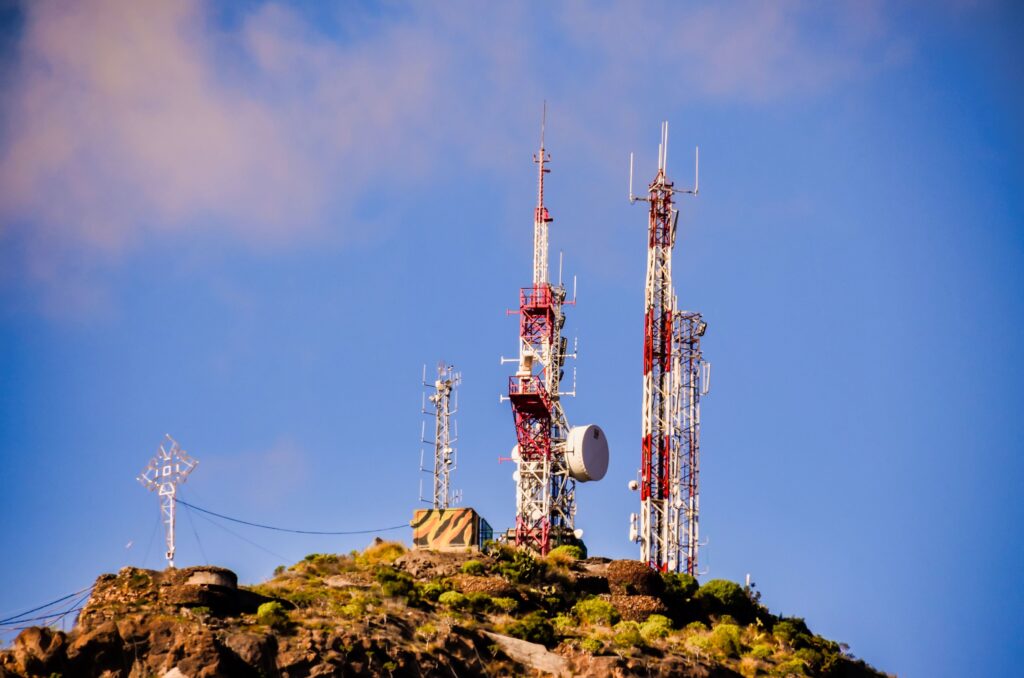
Patterns: The most common pattern is alternating bands of aviation orange and white. The top and bottom bands must always be orange. The number of bands is determined by the tower’s height, with the AC 70/7460-1M providing a table for calculating the appropriate band width. For example, a 500-foot tower would typically have seven bands. Other patterns exist for different structures, like a solid orange pattern for smaller objects or a checkerboard for large water tanks.
Deterioration: The FAA does not mandate a fixed repaint schedule. It mandates that the paint remain within an acceptable color tolerance. Compliance is measured against the FAA’s In-Service Aviation Orange Color Tolerance Chart using a colorimeter. Any visible fading, scaling, peeling, or chipping that takes the color outside the specified delta-E tolerance technically triggers a repaint obligation. Relying on a simple calendar for repaint cycles is a common but flawed practice.
When Obstruction Lighting Eliminates the Paint Requirement
For many tower owners, the right lighting configuration removes the paint obligation entirely. This isn’t a loophole; it’s an explicit alternative designed into AC 70/7460-1M to provide equivalent daytime visibility without the recurring maintenance burden of paint. Understanding this distinction is one of the most significant cost and operational decisions an asset owner can make.
A portfolio owner with dozens of guyed towers may be spending six figures annually on repaint cycles when a significant portion of those assets could qualify for lighting-only compliance, fundamentally changing their long-term operating budget.
Read more: Educational Video Series, Episode 4: Why Some Towers Rely on Paint Instead of Lights
Which Lighting Configurations Qualify for Paint Exemption
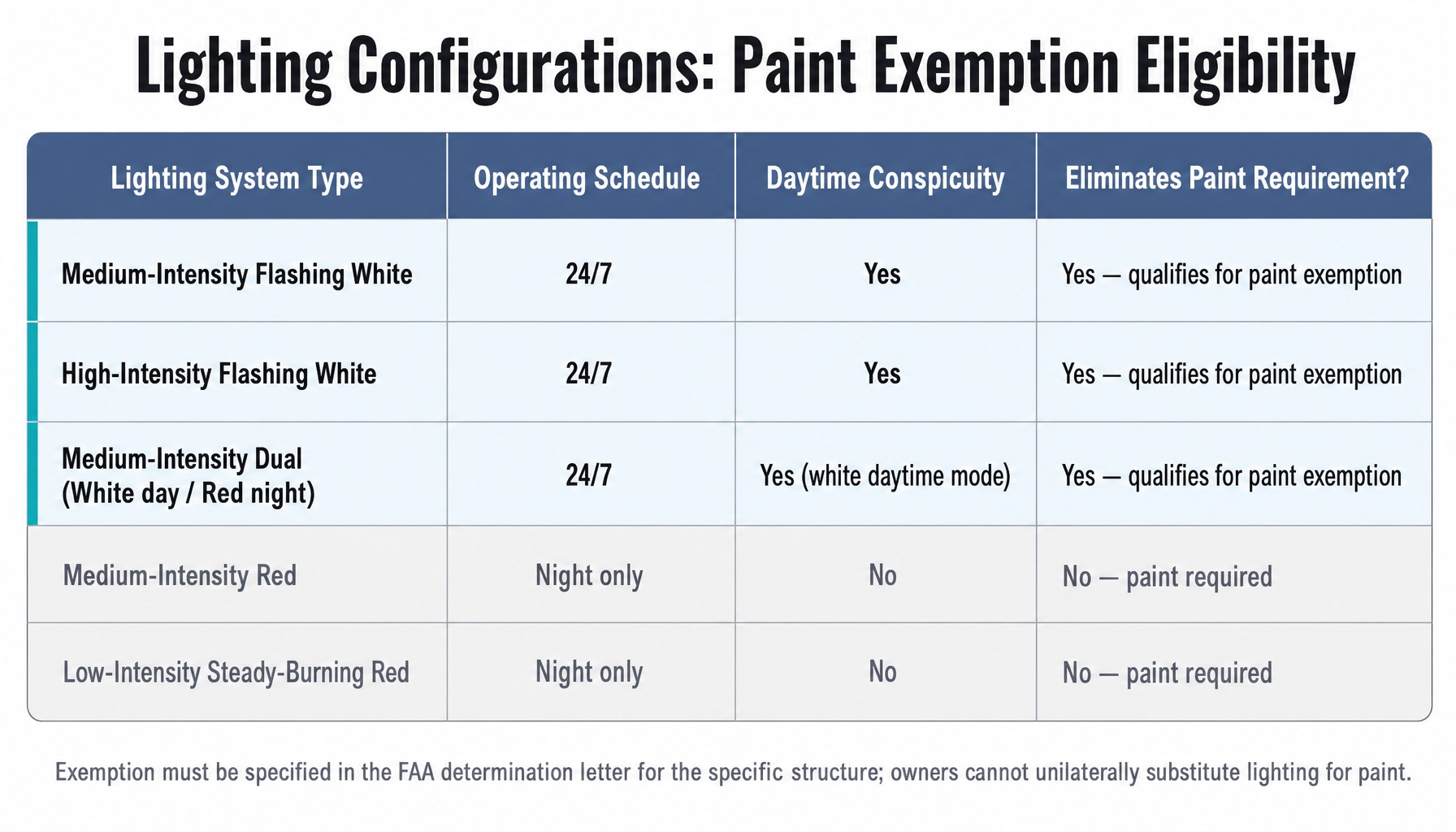
Not all lighting systems eliminate the need for paint. The exemption applies only to systems that provide sufficient daytime conspicuity. The primary configurations that qualify are:
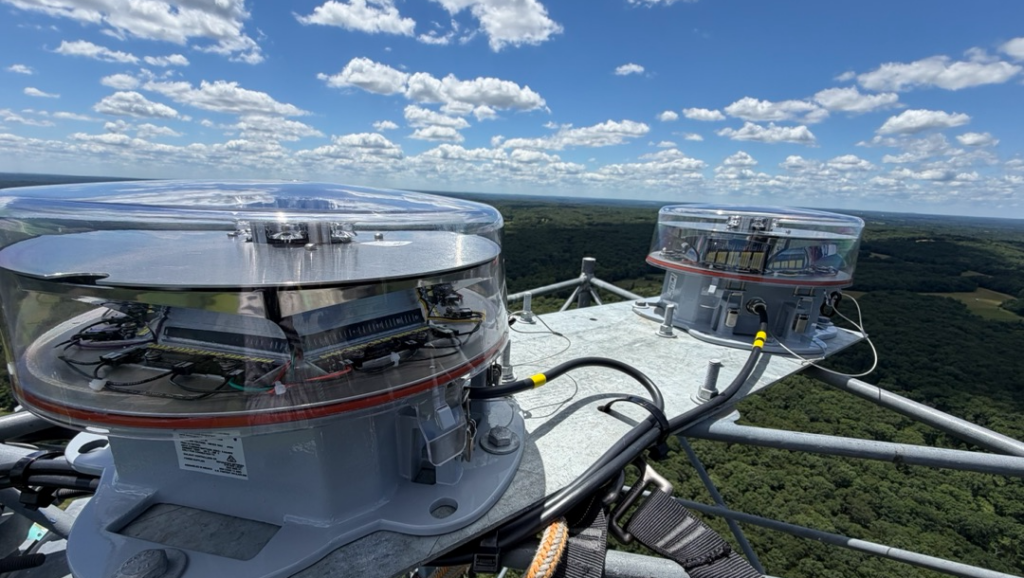
- Medium-Intensity Flashing White Obstruction Lights: These systems, operating 24 hours a day, are bright enough to serve as a daytime marking, replacing the need for paint.
- High-Intensity Flashing White Obstruction Lights: Under AC 70/7460-1M standards, these powerful strobes may also eliminate the paint requirement when they are part of the approved marking and lighting configuration for the structure.
- Medium-Intensity Dual Systems: These systems flash white during the day (providing conspicuity) and red at night (reducing community light pollution). The white daytime operation is what qualifies the tower for paint exemption.
Conversely, systems that only use red lights (e.g., medium-intensity red or low-intensity steady-burning red) do not eliminate the paint requirement. Red lights are not sufficiently visible during daylight hours, so the aviation orange and white paint must serve the daytime marking function. It’s also critical to remember that the substitution is not automatic; an owner can’t unilaterally swap paint for lights. The specific lighting standard must be cited in the FAA determination for that tower.
Evaluating the Paint-to-Lighting Transition for Your Portfolio
For an operator managing a distributed portfolio, the decision to transition from paint to a lighting-only solution is a total-cost-of-ownership analysis. For towers that currently carry a red-light-and-paint configuration, this often means evaluating converting an FAA Style A tower to Style E as part of the broader compliance and cost review.
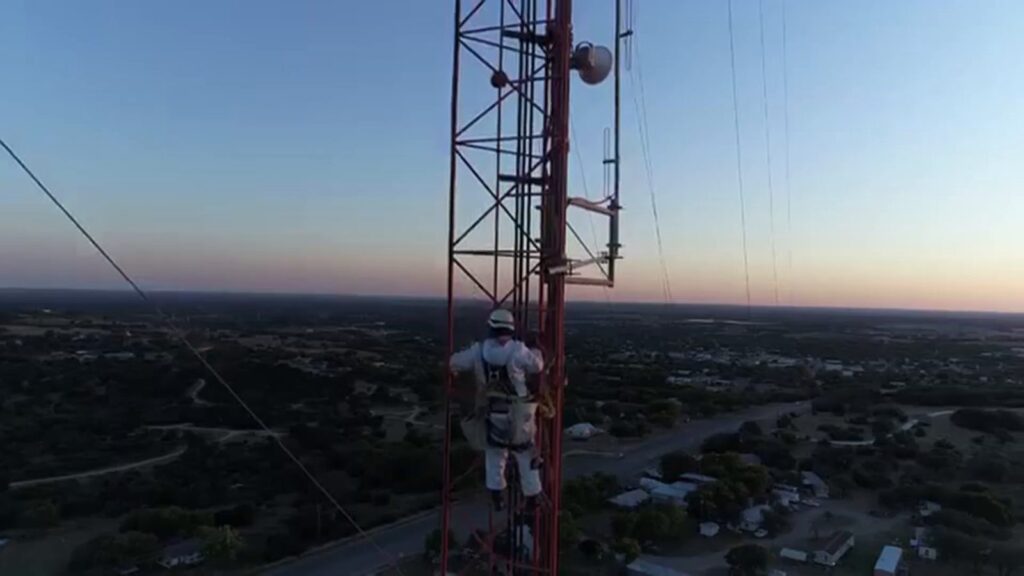
Maintaining paint involves cyclical repainting (every 3-7 years, depending on climate), mobilization of specialized rope access crews, rigorous inspection, and ongoing maintenance planning. This path is characterized by high, periodic capital expenditures.
A lighting-only path has its own costs: the upfront capital for the LED system, ongoing electricity, and eventual maintenance. However, with modern LED systems, maintenance intervals are long and predictable. A service model like LumenServe’s Tower Lighting as a Service (TLaaS®) can even eliminate the upfront capital cost, converting the entire lighting obligation into a predictable monthly operating expense.
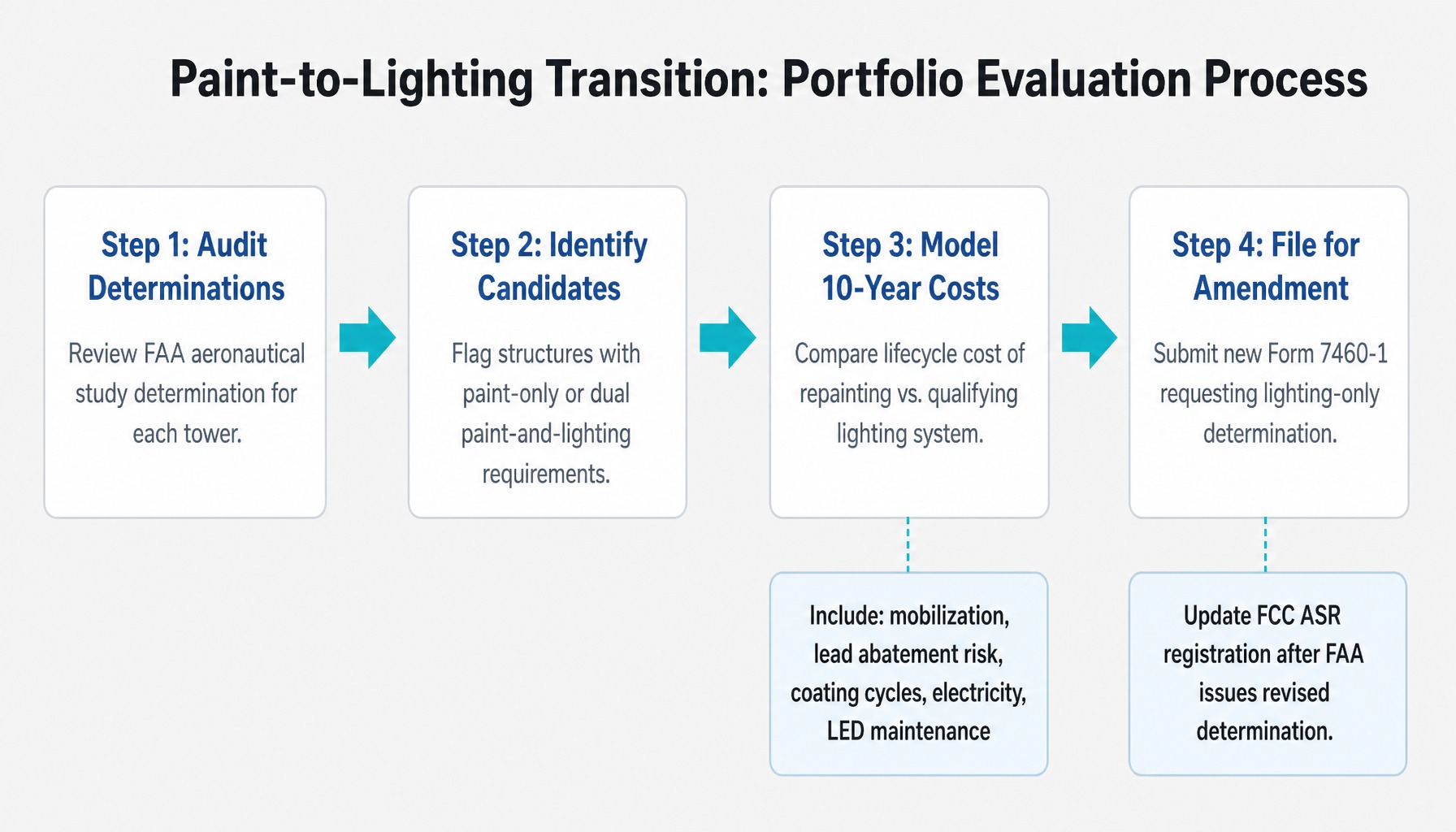
The practical steps for evaluation are:
- Audit Your Determinations: Review the FAA aeronautical study determination for each tower in your portfolio.
- Identify Candidates: Flag every structure that currently carries a paint-only or dual paint-and-lighting requirement.
- Model the Costs: Compare the 10-year lifecycle cost of repainting against the cost of installing and maintaining a qualifying lighting system.
- File for Amendment: For qualified candidates, submit a new Form 7460-1 to request a revised determination for a lighting-only configuration. For TLaaS® customers, LumenServe manages the full filing process and coordinates directly with the FAA as part of the transition.
When Towers Require Both Paint and Lighting
A surprising number of operators assume paint and lighting are mutually exclusive. In reality, many towers are required to carry both simultaneously. This is not redundancy; it reflects the FAA’s risk assessment for structures where both daytime paint and nighttime lighting are deemed necessary for aviation safety.
The most common scenario involves towers equipped with red-only obstruction lighting. Because red lights are not conspicuous during the day, the structure must also have aviation orange and white paint markings to be visible to pilots in daylight. A 400-foot self-supporting tower near a general aviation airport with a determination specifying alternating bands and medium-intensity red lighting is a classic example.
Operationally, these dual-marked towers represent the highest compliance burden in any portfolio. The owner must manage two parallel maintenance streams, each with its own inspection requirements, failure modes, and potential for regulatory violation. A failure in either system faded paint or a burned-out lamp independently creates a non-compliant state and requires corrective action, including a potential NOTAM filing for the lighting outage. For a small operations team managing dozens of sites, this compounded workload can be a significant strain.
Paint Lifecycle: How Climate and Coatings Determine Real Repaint Intervals
The FAA does not tell you when to repaint; it tells you the paint must remain within color tolerance. The difference between those two statements is where most compliance gaps and budget overruns live. The actual repaint interval is determined by environmental exposure and coating quality, not a fixed 5- or 7-year schedule.
Why Geography Changes Your Repaint Budget
Environmental factors are the primary accelerants of paint deterioration. UV radiation, salt air, high humidity, and industrial pollutants degrade coatings at different rates, creating dramatically different maintenance cycles across the country.
A tower in the high-UV, salt-spray environment of coastal Florida or Texas may see its aviation orange fade outside of FAA tolerance in as little as 3-4 years. The same high-performance coating system on a tower in the arid, lower-UV climate of Wyoming could easily last 7-10 years. Because weathering is always most severe at the top of the structure, the top bands often fail inspection first. However, you can’t just repaint the top; the entire tower must be recoated to avoid a visible color mismatch that itself can be a compliance issue. This means repaint budgeting must be site-specific and condition-based, not portfolio-averaged.
Measuring Paint Condition: Visual Inspection vs. Colorimetric Measurement
Here lies a hidden liability for many tower owners. Most operators rely on visual checks from the ground or basic drone fly-bys to assess paint condition. The FAA’s accepted standard is visual comparison against the official FAA In-Service Aviation Orange Color Tolerance Chart, not a casual judgment based only on whether the paint looks acceptable from a distance.
In practice, compliance is assessed by comparing the paint’s color to the FAA In-Service Aviation Orange Color Tolerance Chart. That visual comparison is the accepted standard. However, a tower can still create documentation risk if the assessment is informal or poorly documented. For owners who want a more objective record, advanced tools like colorimeters, calibrated drone cameras, and other structured inspection processes are best practices for verifying and validating the field assessment. These tools are not the FAA’s required standard by themselves, but they can help support a more defensible compliance record and a more consistent maintenance program.
Hidden Compliance Risks Most Tower Owners Overlook
FAA tower painting compliance extends beyond the paint itself. It intersects with contractor qualifications and jurisdictional complexities that can create massive, unbudgeted costs and regulatory exposure.
The Grandfathering Trap: Re-classifying to the Latest Circular
Many tower owners assume that if a structure was approved under an older FAA advisory circular, its marking and lighting requirements remain fixed forever. In practice, existing towers are often grandfathered under the determination and circular in effect at the time of approval, but that grandfathered status can become a trap when changes are made.
Any physical modification to the structure, or any meaningful change to the lighting system, can trigger the need for a new FAA review. Once that happens, the tower may need to be re-classified under the latest applicable FAA Advisory Circular rather than the older standard it originally operated under. That means owners cannot assume that a legacy paint or lighting configuration will carry forward unchanged after a modification.
This matters because many outdated assumptions in the field come from older circulars, including simplified height-based rules that no longer reflect the current standard. The controlling question is not what used to be common practice, but what the latest FAA determination requires after the change is reviewed. For tower owners planning upgrades, conversions, or system replacements, this re-classification risk should be part of the compliance analysis from the start.
FCC vs. FAA: Where Jurisdictional Overlap Creates Enforcement Risk
Tower owners must satisfy two federal agencies. The FAA conducts the aeronautical study and recommends marking and lighting. The FCC makes those recommendations mandatory for antenna structure owners and handles enforcement. This overlap can create confusion.
An owner might satisfy the FAA’s requirements but fail to update their ASR filing with the FCC, triggering a Notice of Violation during a database audit. A routine, like-for-like bulb replacement is simple maintenance and does not by itself create a new compliance filing. But a system-level technology upgrade that changes the tower’s approved lighting specifications, such as the lighting style, controller, or monitoring method, must be documented. Under 47 CFR § 17.57, owners must notify the FCC of changes to marking or lighting specifications, and when the revised system requires FAA review, that process runs through FAA Form 7460-1 for an amended aeronautical study. It is critical to remember that compliance is a two-agency obligation, and your documentation from the initial 7460-1 filing to any subsequent modifications must be consistent and current across both the FAA and FCC systems.
Read more: FAA Tower Lighting Compliance: The Complete Guide
How a Managed Lighting Service Simplifies the Paint-or-Light Decision
Maintaining FAA-compliant paint is expensive, unpredictable, and complicated by general maintenance and environmental risks. Transitioning to a lighting-only solution offers a path to cost certainty but requires capital for new systems and the operational discipline to monitor and maintain them indefinitely.
This is where a managed service model provides a clear resolution. For tower owners evaluating whether to endure another repaint cycle or transition to lighting, LumenServe’s Tower Lighting as a Service (TLaaS®) removes the primary barriers to the lighting path. Instead of a large capital outlay for an LED system, the cost is converted into a flat, predictable monthly fee.
This model shifts the entire burden of tower lighting compliance from system installation and 24/7 monitoring to maintenance, repairs, and FAA/FCC notification management to a specialized provider. It resolves the unpredictable costs of painting and the documentation gaps of manual monitoring by integrating the hardware, software, and operational response into a single, accountable service. It makes the move away from paint operationally and financially feasible.
Talk to LumenServe about eliminating paint marking obligations across your tower portfolio.
Conclusion: From Reactive Repainting to a Proactive Marking Strategy
The FAA tower painting requirements are not a fixed, static obligation. They represent one side of a critical decision between marking and lighting a decision with profound cost, operational, and risk implications.
While understanding the specific paint specs and deterioration thresholds is a necessary part of compliance, the more strategic question is whether each tower in your portfolio should be on the paint path or the lighting path. This requires a clear-eyed analysis of each structure’s aeronautical study, its geographic exposure, and the total cost of ownership for each option.
Tower owners who continue to treat marking as a reactive repaint cycle will always face unpredictable costs and documentation gaps. Those who proactively evaluate each asset against the full range of compliant marking and lighting options can build a more resilient, predictable, and defensible compliance posture for the long term.
Frequently Asked Questions
Do monopoles and small cell towers under 200 feet AGL need FAA paint markings?
Generally, structures under 200 feet AGL do not require FAA obstruction marking unless they penetrate an imaginary surface near an airport, as defined in 14 CFR Part 77. While most small cell installations fall well below this threshold, any new tower construction, regardless of height, should be evaluated through the OE/AAA system to receive a formal determination from the FAA and ensure compliance.
What documentation do I need to prove FAA tower painting compliance during an inspection?
Defensible documentation includes dated, high-resolution photographs of the markings (ideally calibrated against FAA color chips), any colorimetric measurement records, the original FAA aeronautical study determination letter, and the current FCC ASR registration. Records of repainting work, including contractor certifications and paint specs, are also critical. Relying on visual-only records without objective color references is increasingly risky during an official audit.
What happens if a tower owner fails to maintain FAA-required paint markings?
Failure to comply with FAA marking requirements, which are enforced by the FCC under 47 CFR Part 17, can lead to Notices of Violation, significant fines, and orders to correct the issue. In addition to regulatory penalties, a tower with deteriorated markings that is a factor in an aviation incident can expose the owner to severe civil liability.
Can a tower owner request a change from paint markings to lighting-only compliance on an existing tower?
Yes. A tower owner can file a new FAA Form 7460-1 through the OE/AAA system to request a revised aeronautical study with a different marking and lighting proposal. If the FAA determines that the proposed lighting system (e.g., medium-intensity flashing white) provides equivalent daytime conspicuity, it can amend the determination to remove the paint requirement. The FCC ASR registration must then be updated to reflect the new configuration.
What is the typical cost range for repainting a communication tower to FAA standards?
For work performed to meet FAA tower painting requirements , costs vary widely based on tower type, height, and location. In LumenServe’s own true cost of tower ownership study conducted earlier this year, paint and coating material costs ranged from $66 to $82 per gallon, with each gallon covering roughly 400 square feet, and tower crew labor typically ranged from $25 to $80 per tower foot depending on tower type and tower height. Against that backdrop, a 200-foot monopole repaint might range from $15,000 to $30,000, while a 500-foot guyed tower requiring specialized climbing and rope access crews could cost $50,000 to $80,000 or more. Climbing crews, terrain, geographic location, weather windows, coating condition, and other site-specific factors can make the overall job estimate vary wildly.
How does filing FAA Form 7460-1 work for a new tower construction?
FAA Form 7460-1, the “Notice of Proposed Construction or Alteration,” is filed electronically via the FAA’s OE/AAA system. This filing initiates an aeronautical study to assess the structure’s impact on navigable airspace. The FAA then issues a formal determination, typically within 45 days, that specifies the required marking and lighting, if any. This determination document is a prerequisite for obtaining an Antenna Structure Registration (ASR) from the FCC.