Key Takeaways
- Your tower’s specific FAA determination letter and aeronautical study number (ASN) not the general text of FCC Part 17 define your exact obstruction lighting and marking requirements.
- FCC Part 17 compliance is an ongoing operational discipline, focused on monitoring and inspections (47 CFR 17.47), two years of compliance documentation, and outage reporting to the FAA within 30 minutes (47 CFR 17.48).
- Grandfathered status under older FAA circulars is conditional; once a change is made to the tower, the current circular supersedes the old one, which can require an upgrade to current lighting standards.
- The FCC has enforcement authority, but the FAA sets the technical specifications. Understanding this dual-authority structure is critical to managing compliance risk.
- Transitioning from painted markings (Style A) to dual-mode lighting (Style E) is a formal reclassification process that can eliminate recurring paint costs but requires a new FAA determination.
For tower owners and asset operators, FCC Part 17 is the regulation everyone knows exists but few have read end-to-end. The consequences of that gap often materialize as enforcement actions, missed NOTAM windows, and lighting configurations that no longer align with a tower’s actual compliance posture. The core tension is that Part 17 establishes the FCC’s authority over antenna structure marking and lighting, but the actual technical specifications come from the FAA through Advisory Circulars and individual determination letters. This creates a dual-authority environment that many operators need assistance in understanding.
A single unresolved obstruction lighting outage that goes unreported beyond the 30-minute NOTAM filing window exposes the tower owner to FCC enforcement action and a compliance record that complicates future operations. This is precisely the kind of cumulative risk that a robust compliance strategy is structured to intercept before it becomes a regulatory event. If you’re unsure what steps to take when a light goes dark, understanding the tower light out response process is essential.
This guide provides a practical breakdown of what 47 CFR Part 17 actually requires, how the FCC and FAA divide responsibility, and where the highest-risk compliance obligations sit for operators managing distributed assets. This isn’t a legal brief; it’s an operational perspective on navigating the real-world demands of tower lighting compliance.
What FCC Part 17 Actually Covers and What It Does Not
The regulation, formally titled 47 CFR Part 17, Construction, Marking, and Lighting of Antenna Structures, has a scope that is more focused than its name implies. It establishes registration requirements, notification procedures, and the absolute obligation to comply with lighting and marking specifications, but it does not define those technical specifications itself. Instead, it points to the FAA as the source of truth.
For any tower owner, understanding the structure of Part 17 is the first step to de-risking a portfolio. The regulation is organized into three key subparts:
- Subpart A (General Information): This section covers foundational elements, including definitions and the core responsibilities of tower owners. This is where the requirement for an Antenna Structure Registration (ASR) number for applicable towers is established.
- Subpart B (Federal Aviation Administration Notification Criteria): This subpart details the conditions under which an antenna structure owner must notify the FAA of proposed construction by filing FAA Form 7460-1. It defines the height and proximity-to-airport thresholds that trigger an aeronautical study.
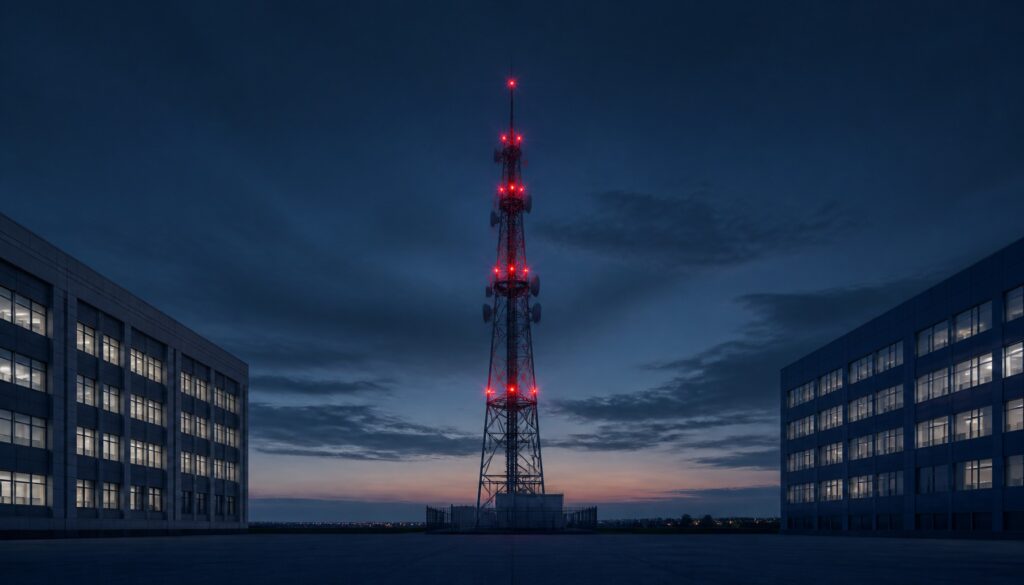
- Subpart C (Obstruction Marking and Lighting Specifications): This is the most operationally significant section, but it contains a critical distinction. Rather than listing specific lighting configurations, it requires each antenna structure to conform to the painting and lighting specifications in its FAA determination and associated study, which apply the FAA advisory circular in effect at the time of that determination.
The practical implication is clear: an operator who reads FCC Part 17 expecting to find their exact lighting configuration such as the requirements for an L-864 red beacon or L-856 high-intensity strobes will not find it there. The regulation creates the legal obligation to comply, but the specific “what” is found in your FAA determination letter.
How FCC Part 17 and FAA Advisory Circular 70/7460-1N Interact
The most common point of confusion in tower lighting compliance stems from the relationship between the FCC and the FAA. Simply put: the FCC has enforcement authority over whether your tower is lit and marked correctly, but the FAA defines what “correctly” means through its aeronautical study process.
This isn’t a bureaucratic technicality; it’s the central mechanism of your compliance obligation. Here’s how it works:
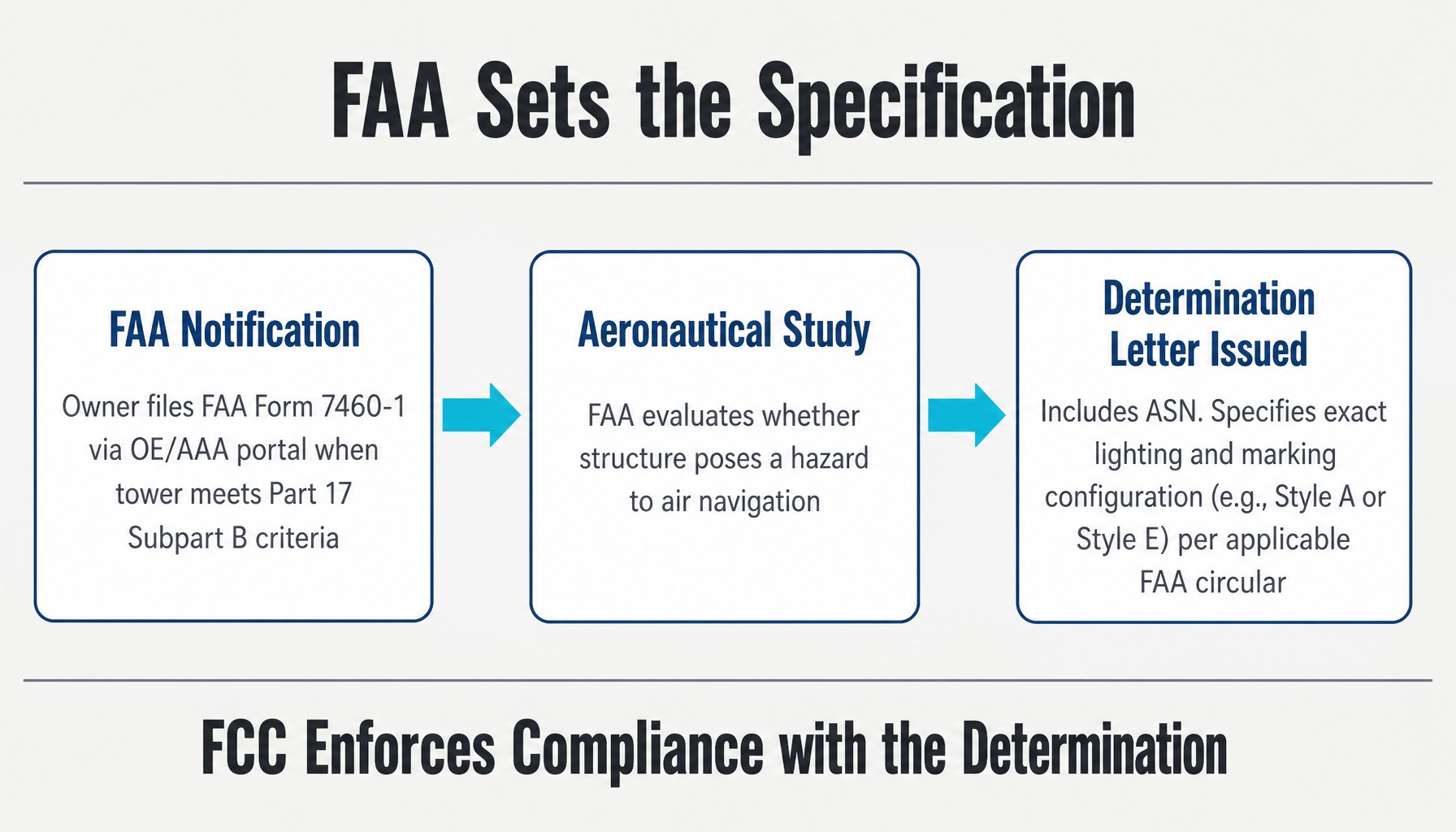
- FAA Notification: When you propose a new tower or a modification that meets the criteria in Part 17 Subpart B, you file FAA Form 7460-1 through the FAA’s Obstruction Evaluation / Airport Airspace Analysis (OE/AAA) portal.
- Aeronautical Study: The FAA conducts a study to determine if the structure poses a hazard to air navigation.
- Determination Letter: Upon completion, the FAA issues a determination letter. This document, which includes your aeronautical study number (ASN), is the single source of truth for your tower’s specific lighting and marking requirements. It dictates whether your structure requires Style A marking, Style E dual-mode lighting, or another configuration based on the standards in the applicable FAA Advisory Circular.
A tower’s compliance obligation is anchored to its specific determination letter and the FAA circular in effect at the time of that determination, not necessarily to whatever circular is currently published. Consider a scenario where an owner inherits a portfolio of 40 structures. An audit reveals that two towers had structural modifications several years ago that should have triggered new aeronautical studies. The result is that those towers have been operating under determinations that no longer reflect the structures as built. The exposure is not hypothetical; it is an open enforcement risk sitting in the portfolio, invisible until someone cross-references determination letters against modification records.
Monitoring Obligations Under 47 CFR 17.47
Section 47 CFR 17.47 is where FCC Part 17 transitions from a registration rule to an ongoing operational mandate. It requires the owner of any registered antenna structure with assigned lighting to ensure those lights are functioning properly.
The regulation provides two methods for meeting this obligation:
- Visual Observation: Observing the lights at least once every 24 hours.
- Automatic Monitoring: Employing an automatic indicator system that provides an alarm upon any failure of the lighting system.
For any operator managing more than a handful of towers, 24-hour visual observation is not operationally viable, making a reliable automatic monitoring system the de facto standard. However, installing a system is not enough. Section 17.47 also requires quarterly on-site inspections of all automatic and mechanical control devices, indicators, and alarm systems. The FCC exempts qualifying NOC-based monitoring systems from the quarterly inspection requirement. To qualify, the system must have self-diagnostic functions (such as alarm notification, 24-hour polling, and manual contact), an operations center staffed to respond to alarms 24/7/365, and a backup operations center in case of catastrophic failure.
Monitoring under 47 CFR 17.47 is not satisfied by simply having a monitoring system installed; the regulation creates an obligation to detect failures and act on them. This means the documentation trail, including daily lighting logs, quarterly inspection results, biennial lens inspection records, and annual paint inspections focused on the upper portions or top half of Style A towers, all kept on file for two years, is just as critical as the hardware. An operator with 50 towers might have a perfect monitoring record but fail an FCC audit because quarterly inspection reports are incomplete for a dozen sites. A centralized portal for tower lighting can help consolidate this documentation and streamline compliance tracking.
NOTAM Reporting Requirements Under FCC 17.51
When an obstruction light fails, the clock starts immediately. Section 17.48 of FCC Part 17 requires the tower owner to report a qualifying outage to the FAA within 30 minutes so a NOTAM (Notice to Airmen) can be issued. The owner must also provide an estimated return-to-service date and update the FAA if repairs run past the NOTAM period. This is a hard-and-fast regulatory mandate, not a best practice.
The 30-minute window is more operationally challenging than it appears. “Discovery” depends entirely on your monitoring reliability and response process. If a lighting failure occurs at 2:17 AM, the on-call person must confirm the alarm is genuine (not a false positive from a photocell transition at dawn or dusk), gather the necessary site information, and file the NOTAM before 2:47 AM. Understanding how to file and clear a NOTAM is a critical competency for every tower operator.
Whether you own one tower or many, consistently meeting this requirement demands a defined, tested workflow, not just a monitoring dashboard. If an alarm routes to a general inbox that isn’t staffed on weekends, or if the designated filer is unavailable, the owner is exposed to regulatory action. The tower owner, not the monitoring vendor, bears the ultimate liability. NOTAM compliance is a process design challenge, and navigating it successfully requires consistent operational focus.
Grandfathered Towers, Structural Changes, and New Aeronautical Studies
Grandfathered towers represent one of the most misunderstood compliance positions in the industry. A tower built and registered under an older FAA circular may be operating with lighting specifications that differ from the current FAA Advisory Circular 70/7460-1N. This is perfectly compliant as long as nothing triggers a new aeronautical study.
The compliance gap appears once a change is made to the tower. Structural modifications, height increases, and changes to marking and lighting can require a new FAA Form 7460-1 filing, and the current circular supersedes the one the tower was built under. When a new aeronautical study is completed, the resulting determination letter will reference the current circular, which may mandate a different lighting or marking configuration than the original installation. For example, a broadcast tower owner planning to add a new antenna array may not realize that this kind of physical modification can change the tower’s weight, wind loading, and overall physical profile. Those changes can require filing FAA Form 7460-1 and may lead to a new aeronautical study and determination letter, but they do not guarantee one. If a new determination is issued, it could require upgrading from an older red-light-only system to a modern dual-mode configuration.
A like-for-like LED replacement that matches the existing determination is not, by itself, a compliance change. As an optional verification step, owners can confirm with the FAA before undertaking a modification whether the planned work will trigger a new study. Grandfathered status is conditional, not permanent, and assuming otherwise is a significant unmanaged risk.
Transitioning from Painted Markings to Dual-Mode Lighting
For towers operating under Style A marking and lighting alternating aviation orange and white paint bands with red obstruction lights the recurring cost of painting is one of the largest and least predictable maintenance expenses. Converting to a Style E dual-mode lighting configuration removes the requirement for aviation orange and white paint. Non-galvanized towers may still need spot painting for rust protection, but they no longer need full repaints.
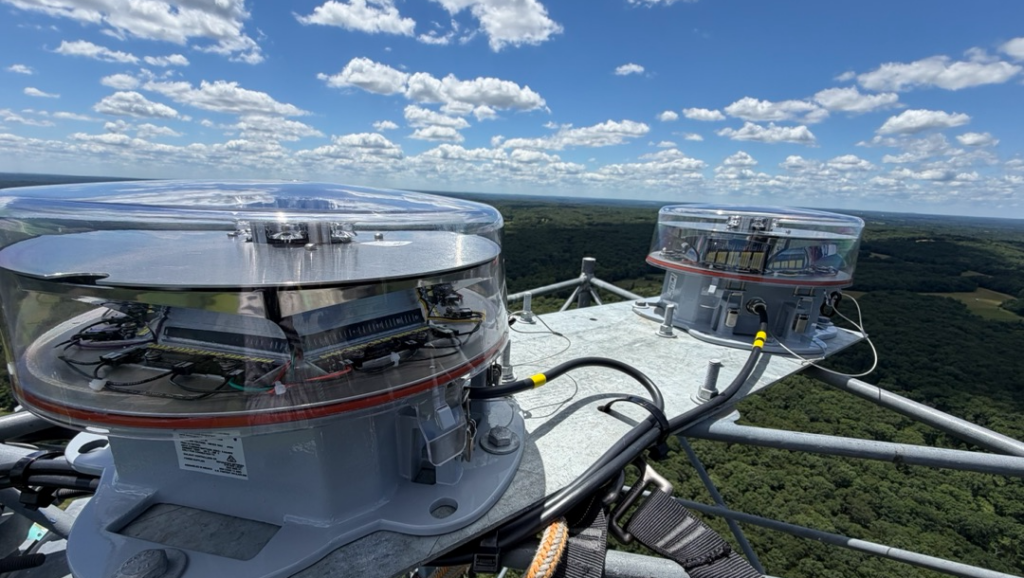
This is the path to never painting your tower again. Style E lighting uses medium-intensity flashing white lights during the day and twilight and flashing red lights at night, removing the need for painted markings. The transition from red lights to a dual-mode system (Style A to Style E) is a formal regulatory process, not just an equipment swap. It requires coordinating with the FAA to obtain a new or amended determination letter that authorizes the change in lighting configuration. For a detailed walkthrough of this process, see how to convert an FAA Style A tower to Style E.
The financial case is compelling. LumenServe’s internal research indicates paint costs can range from $66 to $82 per gallon, and tower crew labor can run from $25 to $80 per foot. Furthermore, regional weather conditions like coastal salt air or high UV exposure can significantly accelerate paint degradation, making lifecycle costs difficult to forecast. By managing the paint-to-light reclassification process, operators can convert this unpredictable capital drain into a fixed, predictable operational state.
Read more: Educational Video Series, Episode 4: Why Some Towers Rely on Paint Instead of Lights
How a Managed Service Model Addresses the FCC Part 17 Compliance Burden
The cumulative argument is clear: FCC Part 17 compliance is not a one-time project but an ongoing operational discipline. It demands active management of monitoring systems, inspection documentation, NOTAM filing workflows, determination letter interpretation, and potential reclassification projects. For a single-tower owner, this burden competes with the core business; across multiple sites, it compounds.
This is the operational gap a managed service model is built to close. Rather than juggling vendors and internal resources, the owner hands the end-to-end operational work to a single service partner, while keeping the regulatory responsibility Part 17 assigns. LumenServe, which pioneered the Tower Lighting as a Service (TLaaS®) model, handles the entire lifecycle:
- Installation: We purchase and install the required LED lighting system, following the specifications mandated by your FAA determination letter.
- Monitoring & NOTAMs: We provide 24/7 compliance monitoring from our Network Operations Center and file NOTAMs on your behalf, averaging under 12 minutes, well within the 30-minute requirement.
- Maintenance & Inspections: We manage all required quarterly and biennial inspections, compliance logs, and repairs under our Assurance Warranty, which covers all parts and labor.
- Reclassification: We directly manage the paint-to-light reclassification process, handling the FAA coordination to eliminate your painting costs.
For towers needing a full system replacement, our TLaaS® model covers installation and all ongoing compliance work, often with no upfront cost for qualified customers. For towers with existing, compliant lighting, our Peace of Mind (POM) Compliance package lets you keep ownership of your lights while LumenServe takes on the obligation: 24/7/365 monitoring, NOTAM filing by our compliance team, and required quarterly and biennial inspections, all for one flat fee. POM requires the existing lighting controller to have dry contacts or be an SNMP-enabled smart system.
With over 1,300+ towers supported nationwide, this model turns a complex compliance headache into a predictable, managed operating expense.
Conclusion
The most important takeaway for any tower owner is that FCC Part 17 compliance is not defined by the regulation text alone. It is defined by the dynamic interaction between FCC enforcement, FAA technical specifications, and your tower-specific determination letter. It requires constant operational discipline in monitoring, documentation, and emergency response.
Part 17 creates the obligation, the FAA circular and your determination letter define the specification, and sections 17.47 and 17.48 create the daily operational requirements where most compliance failures occur. As tower portfolios grow and regulatory scrutiny continues to sharpen, the operators who treat obstruction lighting as a managed service rather than an install-and-forget capital project will carry less risk, face fewer surprises, and spend far less time on compliance logistics.
Frequently Asked Questions
At what height does a tower require obstruction lighting under FCC Part 17?
Antenna structures exceeding 200 feet above ground level generally require FAA notification, which triggers the aeronautical study that determines lighting and marking requirements. However, structures shorter than 200 feet may also require notification based on their proximity to airports, heliports, and established flight paths. The FAA evaluates slope ratios from nearby runways, not just absolute height.
What is the difference between Style A and Style E tower lighting configurations?
Style A uses aviation orange and white paint markings combined with red obstruction lights (L-864 beacons and L-810 steady-burning side lights). Style E uses a dual-mode lighting system medium-intensity white strobes during the day and red lights at night which eliminates the need for painted markings. Towers typically transition from Style A to Style E, not the reverse.
Does upgrading from incandescent to LED obstruction lights change my FCC compliance status?
Upgrading from incandescent to LED lighting does not by itself constitute a compliance change, as long as the new system meets the photometric and operational specifications in your FAA determination letter. The technology is secondary to whether the installed system meets the required flash rate, effective intensity, and configuration for your specific tower.
Who is responsible for obstruction lighting compliance when a tower has multiple tenants?
Under 47 CFR 17.6, the antenna structure owner the entity holding the ASR registration bears primary responsibility for compliance. However, the regulation also places obligations on licensees and permittees. If they discover non-compliance, they must notify the owner and the FCC, and in some cases may be required to bring the structure into compliance themselves.
What are the FCC enforcement penalties for non-compliant tower obstruction lighting?
The FCC Enforcement Bureau can issue Notices of Violation and monetary forfeitures (fines) for failures in lighting, marking, monitoring, and outage reporting. Penalties can compound for ongoing violations, failure to file timely NOTAMs, or incomplete inspection records. Beyond fines, non-compliance creates a serious aviation safety risk and significant liability exposure for the tower owner.
What monitoring equipment is needed to comply with FCC Part 17 remote monitoring rules?
47 CFR 17.47 requires either 24-hour visual observation or an automatic indicator system that alerts the owner to lighting failures. In practice, this means a tower lighting controller with alarm capability, typically using dry contacts or an SNMP-enabled interface to relay status to a monitoring platform. This system must be supported by quarterly on-site inspections unless it is a qualifying NOC-based monitoring system with self-diagnostic functions, a 24/7/365 staffed operations center, and a backup operations center.