Key Takeaways
- An Antenna Structure Registration (ASR) is a record in the FCC’s database, but it is not the same as the FAA’s Aeronautical Study Number (ASN) and does not guarantee compliance.
- You can perform an ASR lookup for any registered structure using the public FCC ASR Registration Search tool in several ways. Common examples include searching by ASR number, geographic coordinates, or state and county, but other options are also available, such as owner name, towers within a radius of a point, FCC ID, and Owner TIN with ZIP code.
- The lighting style listed on your ASR record reflects the requirements at the time of registration; it may not match your current obligations if a newer FAA determination letter has been issued.
- To verify compliance, you must compare your ASR record to your most recent FAA determination letter and then compare that letter to the lighting system physically installed on your tower.
- Structural modifications, such as increasing height by adding an antenna, can trigger the need for a new FAA aeronautical study, which may result in new lighting requirements.
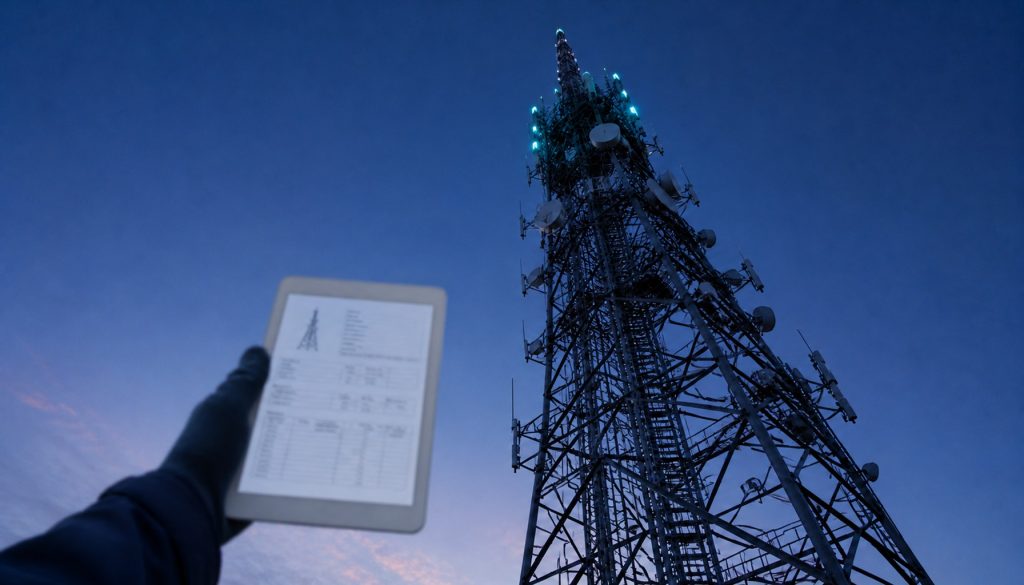
An insurer requests your tower’s Antenna Structure Registration (ASR) number for a policy renewal. A new co-locator needs it for their application. Or perhaps an internal review flags it as a required piece of documentation. For many tower owners and operators, this is a familiar, if infrequent, request. You know the number exists, but you may not be sure where to find it or what the record actually shows.
The FCC’s Antenna Structure Registration system is the official public database for registered antenna structures in the United States. Knowing how to perform an ASR lookup is a fundamental skill for anyone responsible for a regulated structure.
This guide will walk you through how to find and read your ASR record. More importantly, it will explain what that record does not tell you about your current FAA obstruction lighting and compliance obligations a gap where significant financial and regulatory risk can hide.
What Is an ASR Record and What Does It Contain?
An Antenna Structure Registration, or ASR, is simply your tower’s record in the FCC database. It applies to structures that meet certain registration criteria under 47 CFR Part 17, such as structures that exceed 200 feet above ground level (AGL) or may affect nearby airspace. Each registered structure is assigned its own ASR number, and that is usually the first identifier people go looking for when questions come up about a site.
One place people get tripped up is confusing the ASR number with the Aeronautical Study Number, or ASN. They are not the same thing. The ASN comes from the FAA during the aeronautical study process, which starts with FAA Form 7460-1. The ASR number comes from the FCC and identifies the registration itself. In real life, this mix-up happens all the time. Someone asks for the ASR for a co-location application or a compliance review, and the number pulled from an old FAA determination letter turns out to be the ASN instead. That matters because the ASR is the FCC registration record, while the FAA study and the resulting determination letter are what tell you what marking and lighting specifications govern that structure.
And this is where it starts to matter beyond paperwork. If the tower has been modified and the records no longer line up with the physical structure, that can create real problems at inconvenient times. A lender may ask for a valid FAA Determination of No Hazard during refinancing. An insurer may want the same thing during renewal. A buyer, tenant, or legal team may spot a mismatch during diligence or lease negotiations. When that happens, what looked like a simple record check can suddenly turn into delays, added scrutiny, or questions about coverage. That is why an ASR lookup is a starting point, but the FAA determination letter is still the document you need to verify closely.
Key Fields in an ASR Registration Record
When you perform an ASR lookup, you will see several key fields. Here is what the most important ones mean for a tower owner:
- Registration Number: The unique ASR number assigned to your structure by the FCC.
- Structure Type: Describes the tower, such as a guyed or self-supporting tower (TOWER), pole (POLE), or building (BLDG).
- Overall Height AGL & AMSL: Shows the structure’s height Above Ground Level (AGL) and Above Mean Sea Level (AMSL).
- Coordinates: The precise latitude and longitude of the structure.
- Structure Owner: The legal name of the entity that owns and is responsible for the structure.
- FAA Study Number: The ASN from the FAA aeronautical study that corresponds to the registration.
- Marking & Lighting Specifications: The painting and lighting requirements on file, usually shown as references to FAA advisory circular chapters plus a short description (such as “medium intensity dual”), as of registration or the last update. This is a critical field, but it may not reflect your current requirements.
- Registration Status: Shows where the structure stands, such as Granted (approved but not yet built), Constructed, or Dismantled.
How to Look Up an ASR Number in the FCC Database
The FCC’s Antenna Structure Registration search tool is publicly accessible and does not require a login for basic searches. You can find it at: https://wireless2.fcc.gov/UlsApp/AsrSearch/asrRegistrationSearch.jsp.
Imagine you are a utility operations manager who has inherited responsibility for a transmission structure and needs to confirm its registration status. You don’t have the ASR number, but you do have its GPS coordinates from an internal GIS system.
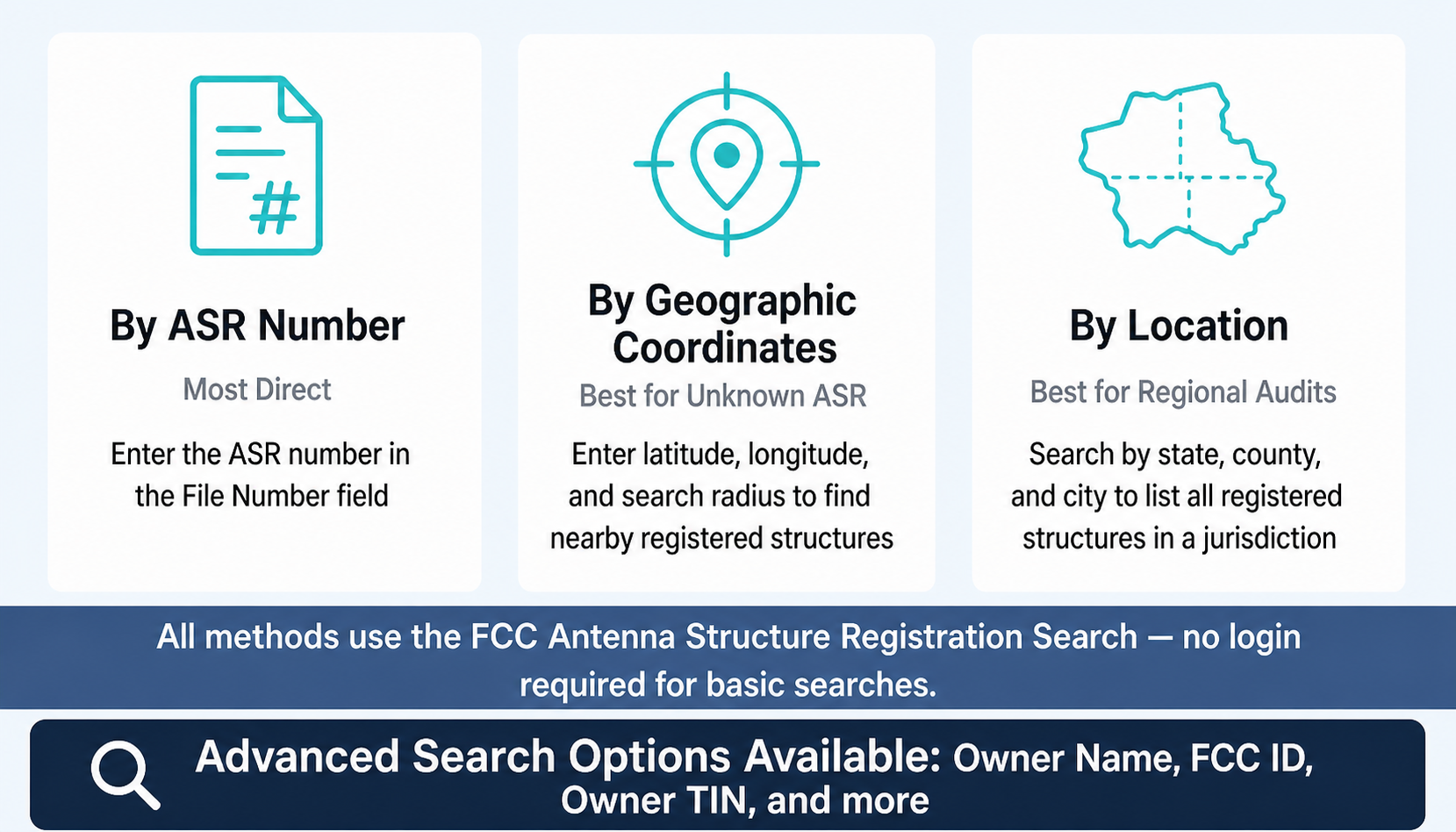
There are a few main ways most people start an ASR lookup:
- By ASR Number: If you already have the number, this is usually the fastest path. Just enter it in the “Registration Number” field and search.
- By Geographic Coordinates: If you know the tower’s location but not its number, you can search by latitude and longitude. Enter the coordinates and a search radius to find registered structures in that immediate area. This is how the utility manager would likely find the structure.
- By Location: You can also search by state, county, and city to see a list of registered structures in a given jurisdiction. It is less precise, but it can be useful for regional audits.
Those are the primary search methods, but they are not the only ones. The FCC database also includes other search options, such as owner name, FCC ID, or Owner TIN, and there is an advanced search function if you want to narrow things down further. In most cases, though, the three methods above are the best place to start.
The results page will show matching structures, and clicking on an ASR number will take you to the detailed registration record containing the fields described above.
Finding an ASR Without the Registration Number
If you don’t have the ASR number handy, you are not out of luck. Beyond the FCC’s coordinate search, you can often find the ASR number referenced in other documents. The FCC’s registration notice (Form 854-R), issued when the structure was registered, lists the ASR number. If you have the FAA’s Aeronautical Study Number from your determination letter, you can also search the ASR database by FAA study number, since each ASR record lists its ASN.
The FAA’s Obstruction Evaluation / Airport Airspace Analysis (OE/AAA) system is another resource for researching aeronautical studies. Additionally, the FCC’s TOWAIR screening tool can help determine whether a proposed structure at a given location and height would likely require FAA notification and ASR registration, though it is a preliminary tool and does not replace a formal aeronautical study.
What Your ASR Record Does Not Tell You About Lighting Compliance
Here is the most important takeaway for any tower owner: pulling up your ASR record and seeing a lighting style designation does not confirm that your tower is currently compliant.
The ASR record is a snapshot in time. It reflects the lighting and marking specifications that were required when the structure was first registered or last administratively updated. It does not automatically update when a new determination letter is issued for your tower. A new circular alone doesn’t change a tower’s requirements either: only certain changes can move a tower under the current circular, so check with the FAA and FCC to confirm.
Take a situation many people in broadcast would recognize. An engineer pulls up the ASR record for a 450-foot guyed tower and sees the lighting style that has been sitting in the database for years. On the surface, everything looks fine. But the tower had a height increase in 2019, which led to a new FAA determination letter with different lighting requirements, and the ASR record never caught up. That is where people get misled. The database can look clean while the controlling FAA document says something else. If you want to know what actually governs that structure, the FAA’s official aeronautical study and resulting determination letter are what you need to verify.
The ASR record also does not indicate whether a tower’s lighting system is currently monitored, whether inspection logs are being maintained, or whether any Notice to Airmen (NOTAM) has been filed for an outage. A clean-looking registration can mask active operational failures. The FAA determination letter not the ASR record contains the binding instructions for your structure.
When a Registered Tower Needs a New FAA Aeronautical Study
An active ASR does not mean a tower’s FAA requirements are permanently fixed. Certain physical changes can trigger the need for a new aeronautical study, which involves filing FAA Form 7460-1, even on a structure that has been registered for years.
Common triggers include:
- Increasing the overall height of the structure, including from the addition of new antennas or other appurtenances.
- Changing the structure type (e.g., replacing a guyed tower with a self-supporting one).
- Relocating the structure, even by a short distance.
For example, if an E911 tower owner adds a new antenna platform that increases overall height by 15 feet, they must evaluate whether a new study is required. While adding an antenna array can trigger a new determination letter, it is not guaranteed; the FAA evaluates each case individually. It is also important to understand that reaching 200 feet AGL requires submitting Form 7460-1 for a study, but it does not automatically mean obstruction lights are required. Only the FAA’s official aeronautical study and resulting determination letter provide a definitive answer for your specific structure.
If a new study is performed, the resulting determination letter supersedes the previous one and becomes the new source of truth for your lighting obligations.
Using ASR Data to Audit Your Tower’s Current Lighting
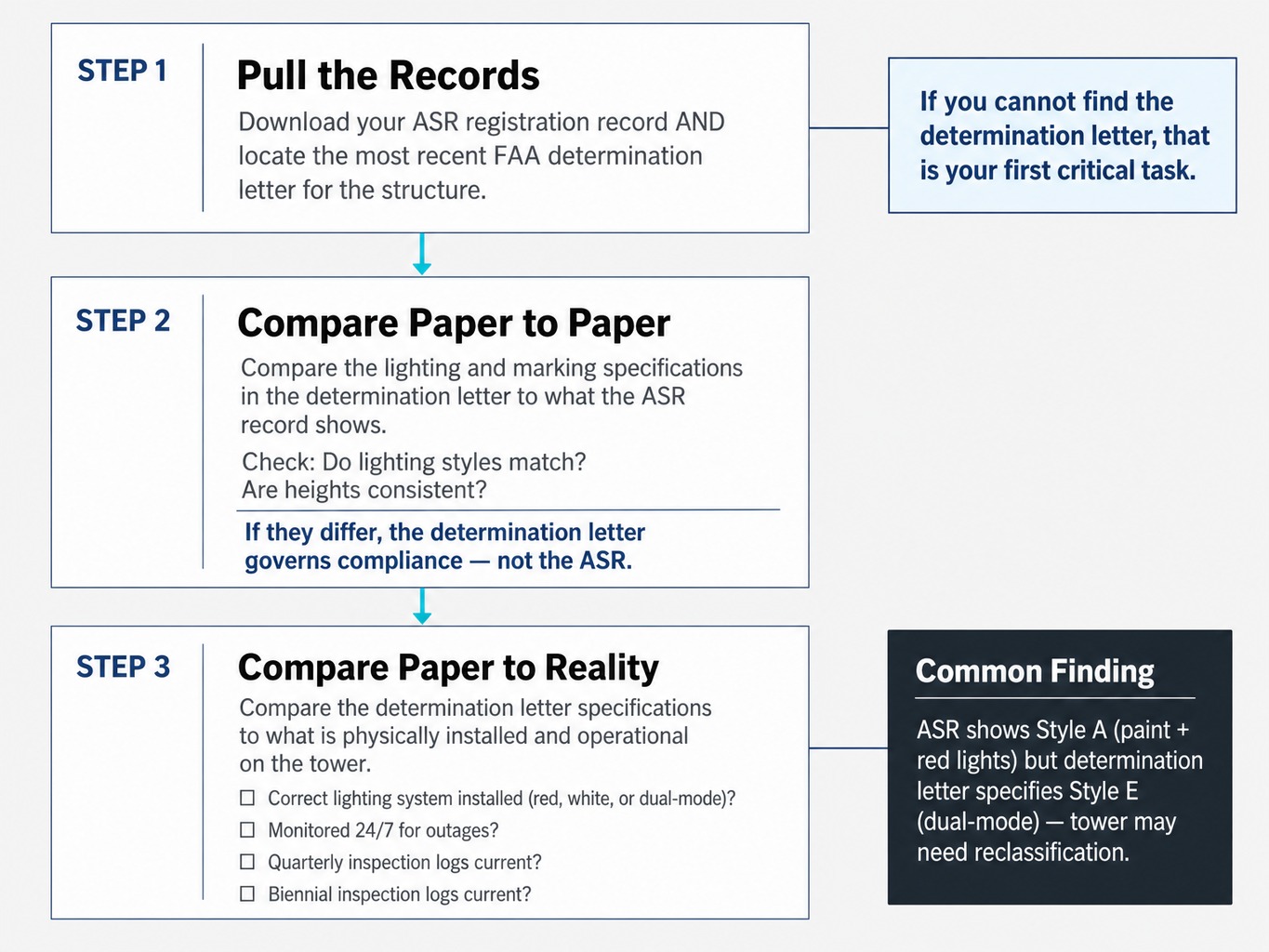
If your ASR record and your real-world compliance status are not fully lining up, the fix is usually straightforward and starts with a simple audit. After performing an ASR lookup, take these three practical steps:
- Pull the Records: Download your ASR registration record and locate the most recent FAA determination letter for that structure. If you can’t find the determination letter, you have found your first critical task.
- Compare Paper to Paper: Compare the lighting and marking specifications in the determination letter to what the ASR record shows. Do the lighting styles match? Are the heights consistent? If they differ, the determination letter is the document that governs your compliance.
- Compare Paper to Reality: Finally, compare the determination letter’s specifications to what is physically installed and operational on your tower. Is the correct lighting system in place (e.g., red, white, or dual-mode)? Is it being monitored 24/7 for outages? Are your quarterly and biennial inspection logs current?
A broadcast tower owner performing this audit might discover their ASR shows Style A (paint and red lights), but their determination letter specifies a Style E dual-mode system. That can happen when a Style A to Style E reclassification was approved but the installation was never completed, or the ASR was never updated. Either way, the records and the tower need to be brought back in line. If you’re considering that move, LumenServe directly drives and manages the paint-to-dual-mode transition for prospects and customers. Learn more about how to convert an FAA Style A tower to Style E to understand what that process involves.
Read more: FAA Tower Painting Requirements: A Guide to Marking, Lighting, and Compliance – LumenServe
When Managing Your Tower’s ASR and Compliance Becomes Too Much to Handle
Looking up your ASR is the easy part. What takes time is everything that comes after, reviewing records, keeping inspections on track, watching for outages, filing a Notice to Airmen (NOTAM) within the required 30 minutes, and keeping documentation in order.
For a lot of tower owners, especially public safety agencies, broadcast stations, and utilities with only a handful of structures, this is the kind of responsibility that gets pushed aside until something goes wrong.
If you do not want to manage all of that in house, you can hand it off to a specialist. With LumenServe’s Tower Lighting as a Service (TLaaS®) model, we buy and install a new LED lighting system, then handle 24/7 monitoring, Notice to Airmen (NOTAM) filing within 30 minutes, required inspections, compliance records, maintenance, and repairs for a flat monthly cost. We support more than 1,300 towers nationwide.
If your existing lighting system is working but you need expert support for monitoring and compliance, our Peace of Mind Compliance Package provides that oversight for systems with dry contacts or SNMP-enabled controllers.
Your ASR Is a Starting Point, Not the Finish Line
Your tower’s ASR record is an essential starting point for understanding its registration status. But it is not a compliance audit. The true picture of your obligations is found by comparing that record to your current FAA determination letter, the governing FAA circular, and the physical condition of the equipment on your tower.
Looking up your ASR takes a few minutes. Confirming that your lighting, monitoring, inspections, and documentation are all current and aligned takes ongoing attention. Whether you manage this process internally or work with a specialist, the first step is knowing what your records say and what they leave out.
Frequently Asked Questions
Is the ASR number the same as the FCC registration number?
Not quite. The ASR number identifies the structure itself. The FCC Registration Number (FRN) is a separate 10-digit number that identifies the owner, or any entity doing business with the FCC. Both can appear on an ASR record, so it helps to know which one you’re being asked for. Neither is the same as the FAA’s Aeronautical Study Number (ASN), which is assigned during the 7460-1 aeronautical study process.
Can I search the FCC ASR database by GPS coordinates or street address?
The FCC’s ASR Registration Search accepts latitude and longitude coordinates, which is the most reliable geographic search method. It does not support street address searches directly. If you only have an address, you can convert it to coordinates using a standard mapping tool first, then use those coordinates to search the FCC database.
Who is responsible for keeping the ASR record current the tower owner or the tenant?
The structure owner (registrant) listed on the ASR is responsible for all aspects of the registration. This includes filing updates when the structure is modified, ownership changes, or the structure is dismantled. While co-locators and tenants have their own FCC obligations, they do not manage the tower’s ASR.
How do I verify whether my tower’s ASR is still active or has been decommissioned?
Search for the ASR number in the FCC Registration Search and check the “Registration Status” field. A built, active structure typically shows “Constructed”; “Granted” means the registration was approved but construction hasn’t been reported. When a structure is dismantled, the owner must notify the FCC on Form 854 within 5 days. If a structure has been dismantled, the owner should have filed for cancellation. An outdated status may indicate required updates were never submitted.
Can I find another company’s tower ASR number using the FCC public database?
Yes. The FCC ASR database is a public record. You can search by geographic coordinates, state, county, or owner name to find ASR records for any registered structure, regardless of who owns it. This is commonly done for co-location research, interference analysis, and real estate due diligence.
What should I check in the ASR record when buying or selling a tower?
During due diligence, confirm that the ASR record’s owner, height, coordinates, and FAA study number match the structure and its most recent determination letter. After closing, the change in ownership must be reported to the FCC on Form 854 within 5 days, and the FAA should also be notified so its records reflect the new owner. Until both are done, the seller remains the owner of record.